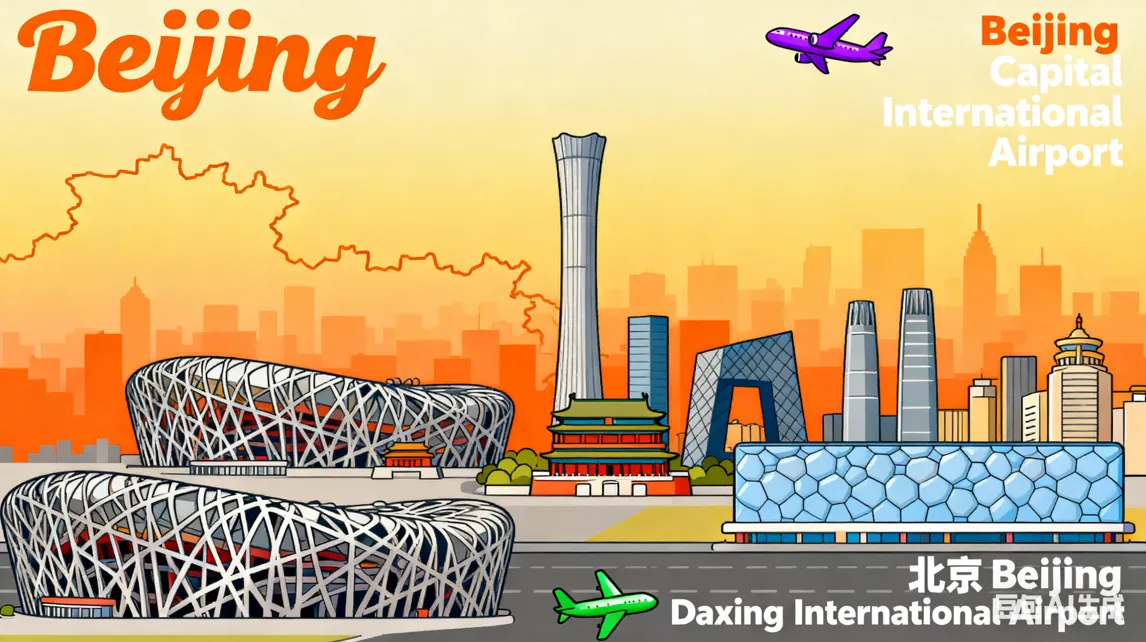
Planning a trip to China's bustling capital? When flying to Beijing, China's bustling capital, international travelers often face a common question: Should I fly into PEK (Beijing Capital International Airport) or PKX (Beijing Daxing International Airport)? Which Beijing airport is better? Both airports are world-class gateways to China, but they differ in location, design, transportation options, and overall travel experience. This comprehensive guide compares PEK vs. PKX to help you choose the best airport for your trip.
📌 TL;DR: The Quick Answer
- Choose PEK (Capital Airport) if you are flying Air China / Star Alliance, staying in eastern/northern Beijing (like Chaoyang or Sanlitun), or planning to visit the Mutianyu Great Wall directly from the airport.
-
Choose PKX (Daxing Airport) if you are flying China Eastern, China Southern / SkyTeam, prefer a hyper-modern and less crowded terminal with minimal walking, or have a tight connecting flight layover.
1. Quick Facts: At a Glance Comparison
The most significant differences boil down to age, location, and design efficiency.
| Feature | Beijing Capital International (PEK) | Beijing Daxing International (PKX) |
| IATA Code | PEK | PKX |
| Location | Northeast of Downtown Beijing | South of Downtown Beijing |
| Opened | 1958 (T3 opened in 2008) | 2019 (The newest major global hub) |
| Design | Multiple Terminals (T1, T2, T3) | Single-structure Terminal (The "Starfish") |
| Walking Time | Long walking distances between terminals/gates | Very compact; Max 8-minute walk to the farthest gate |
| Typical Airline Alliances | Star Alliance (e.g., Air China) | SkyTeam (e.g., China Southern, China Eastern) |
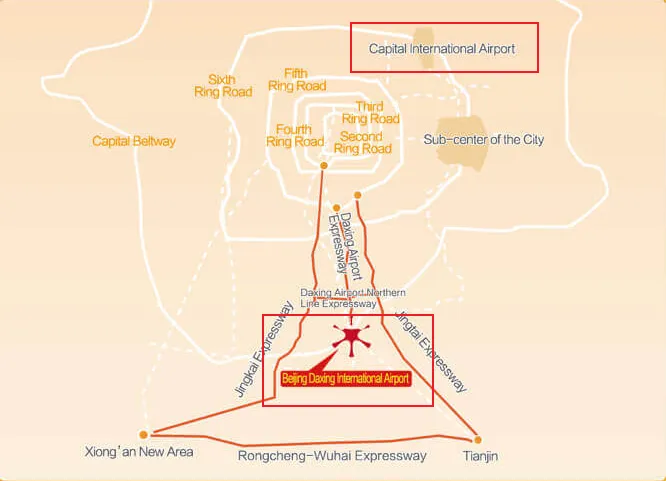
2. Location and Transportation Time to Beijing Downtown
When comparing PEK vs. PKX, the travel time to your hotel is often the biggest deciding factor, especially after a long international flight.
📍 Beijing Capital International (PEK)
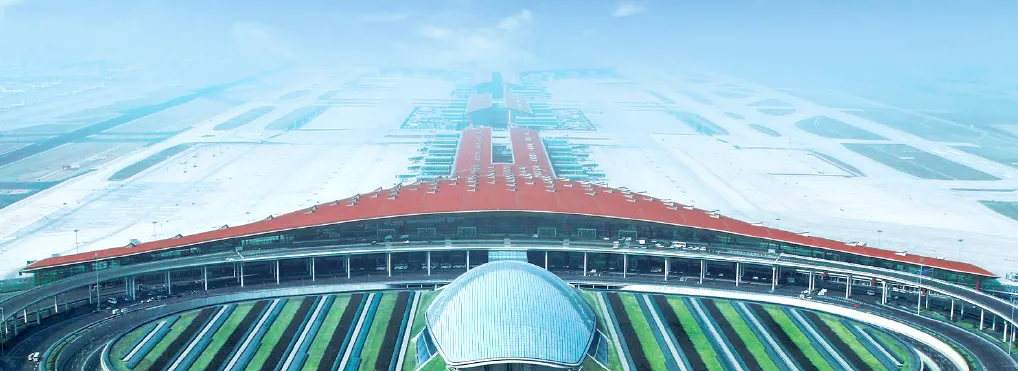
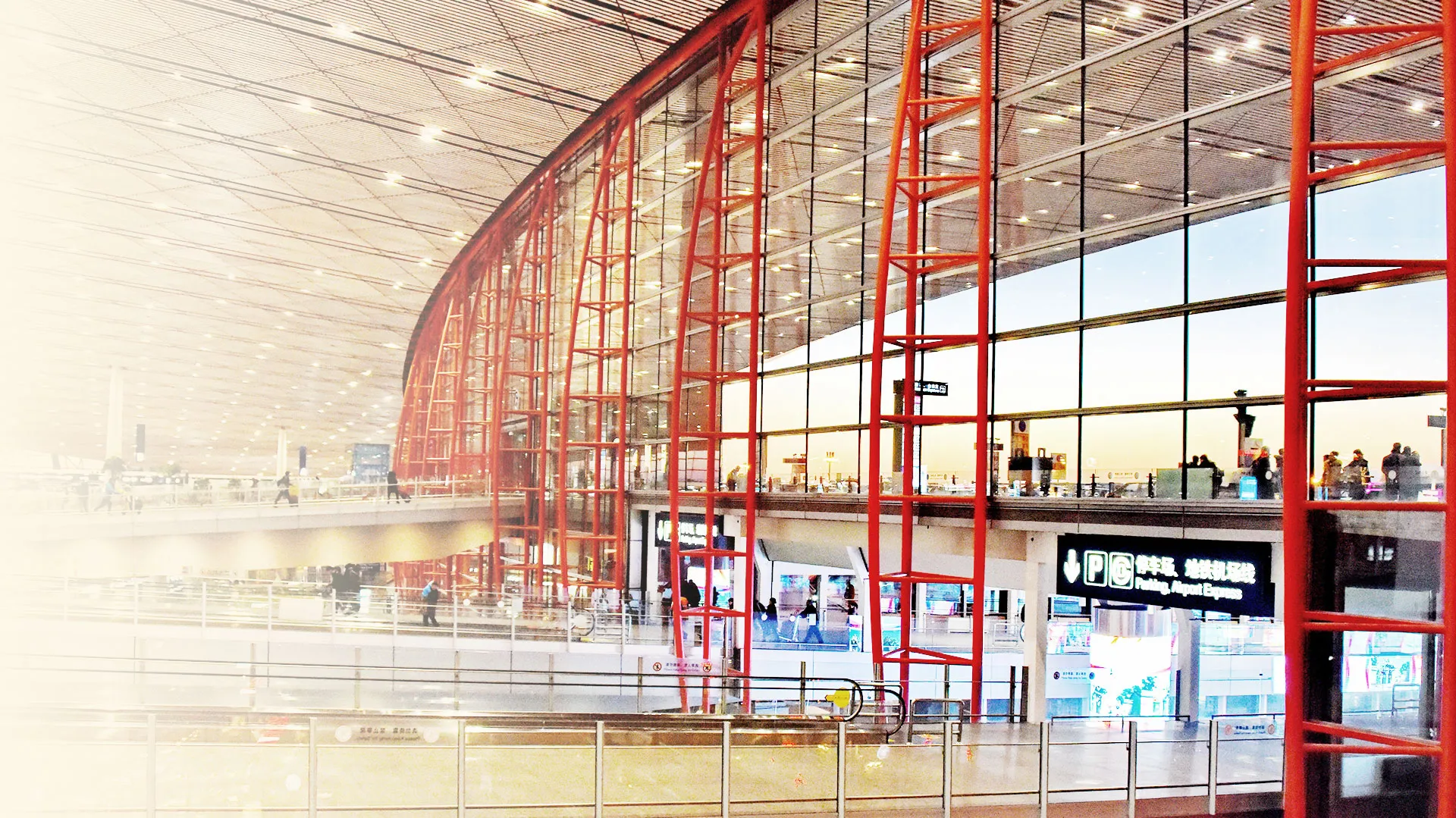
Location: Airport Road, Chaoyang District, Beijing, 100621, China. Located in Shunyi District, northeast of downtown Beijing, PEK is closer to the city's central business area. It's ideal if your hotel is in Chaoyang District or near Wangfujing.
Distance to Tiananmen Square (City Center): Approx. 32 km (20 miles).
Transportation to City Center
| Transport Mode | Travel Time | Cost (CNY) | Operating Hours | Departure Point | Pros | Cons | Best For |
|---|---|---|---|---|---|---|---|
| Airport Express Train 🚆 | 20 min | 25 | 6:00 AM – 11:00 PM | T2/T3 Basement (B2) | Fast, cheap, reliable, connects to Subway Line 2/10/13 | No luggage storage, ends at Dongzhimen (need transfer) | Budget travelers, light luggage, in a hurry |
| Airport Bus (Shuttle) 🚌 | 60–90 min | 24–40 (varies by line) | 24/7 (most lines until last flight) | T1: Gate 11 (1F) T2: Gate 9–11 (1F) T3: Gate 1–5 (1F) | Many routes (to Beijing Railway Station, Xidan, Princess Grave, etc.), affordable | Traffic delays, crowded during peak hours | Groups, moderate luggage, specific drop-offs |
| Taxi / Rideshare (Didi) 🚕 | 45–90 min |
Approx. ¥100 - ¥150 |
24/7 | Official Taxi: T1 (Gate 1), T2 (Gate 5), T3 (Gate 1–3) Didi Pickup: Designated zones (follow signs) | Door-to-door, luggage-friendly, English app option | Traffic jams, surge pricing, language barrier (taxi) | Late arrivals, heavy luggage, families, comfort |
📍 Beijing Daxing International (PKX)
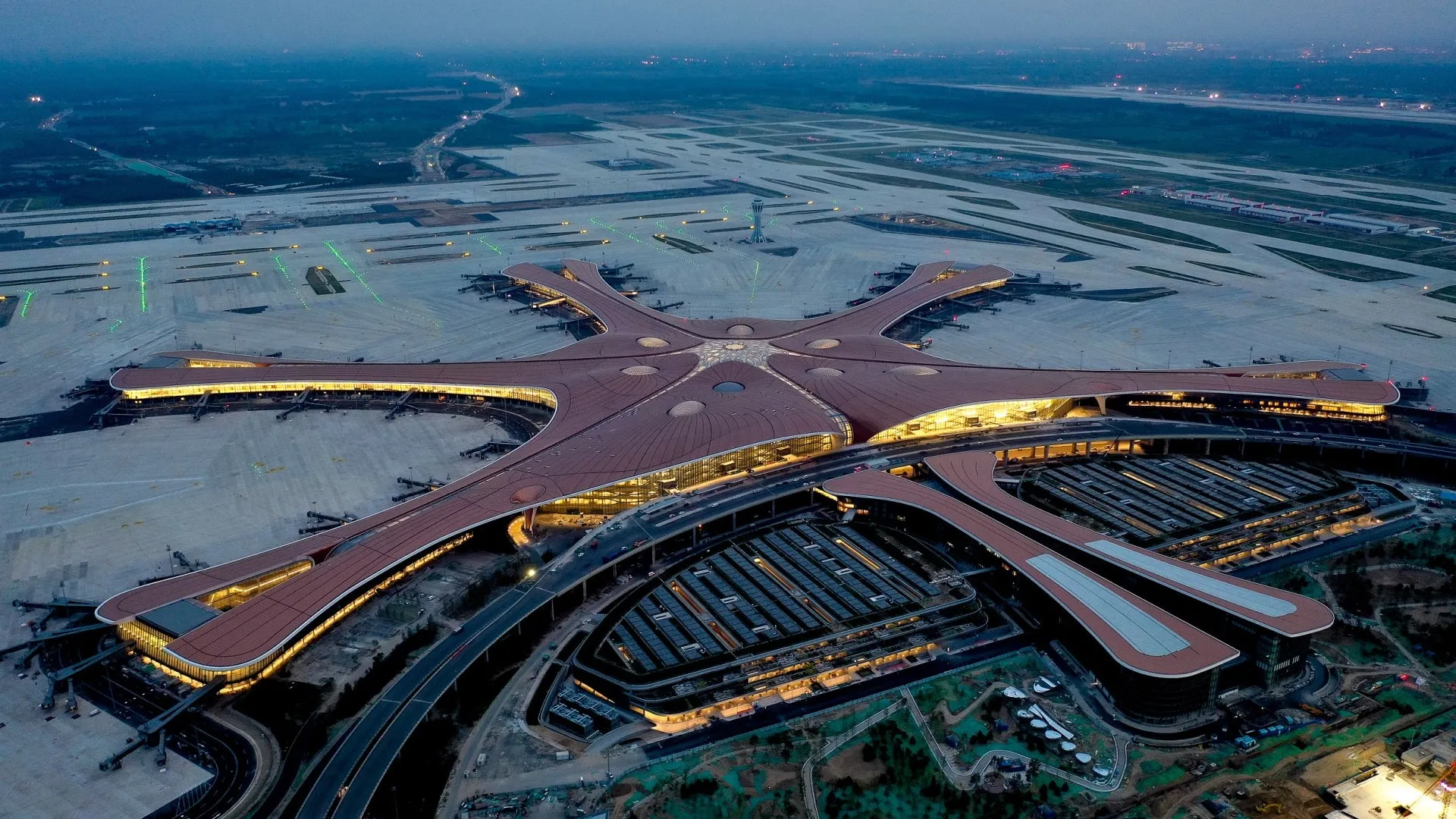
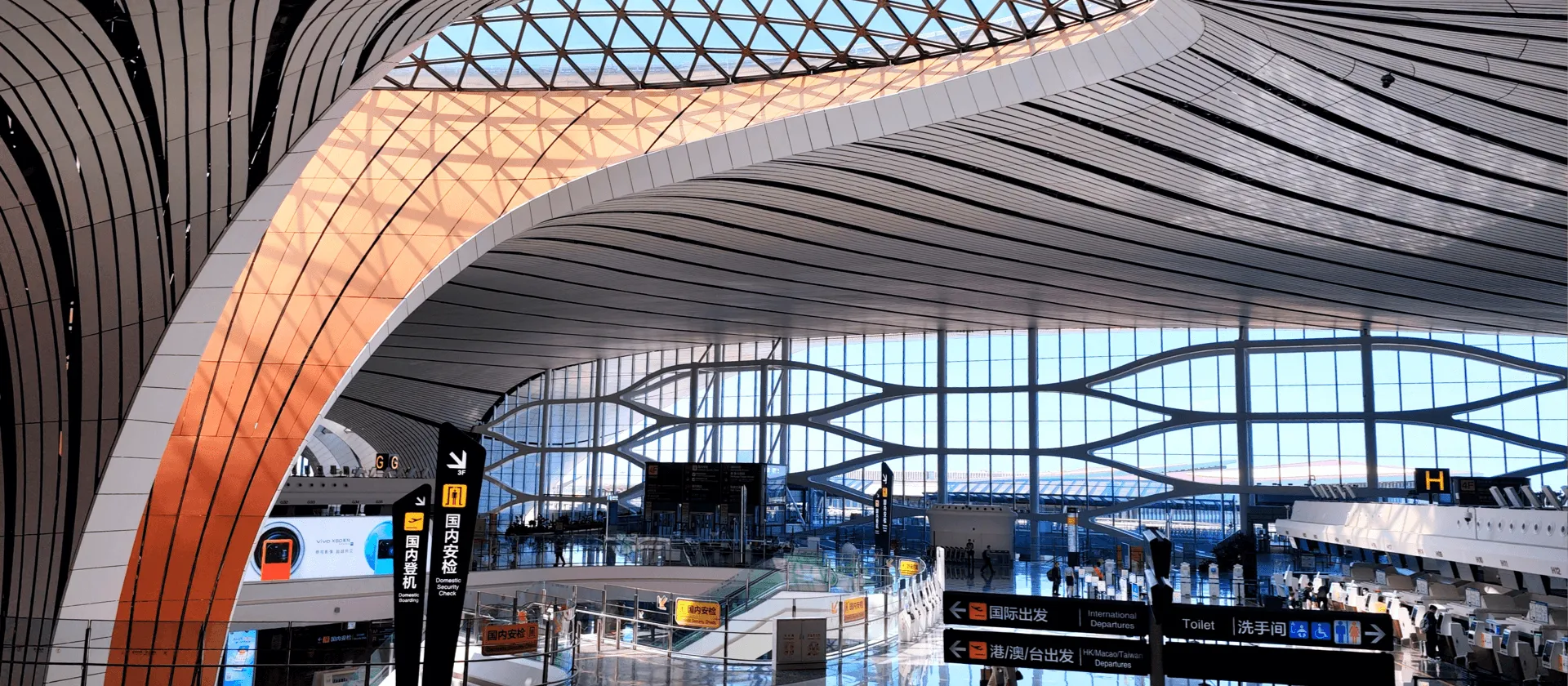
Location: PKX sits about 46 km south of Tiananmen Square and serves as the southern gateway to Beijing. Its location in Daxing District (the southern suburbs of Beijing) is ideal for serving the Chinese capital and the neighboring areas of Hebei and Tianjin.
Distance to Tiananmen Square (City Center): Approx. 46 km (29 miles).
Transportation to City Center
| Transport Mode | Travel Time | Cost (CNY) | Operating Hours | Departure Point | Pros | Cons | Best For |
|---|---|---|---|---|---|---|---|
| Airport Express Train 🚇 | 20–25 min | 35-50 | 6:00 AM – 11:00 PM | B1 Level (near Domestic Arrivals) | Ultra-fast, modern, direct to Caoqiao (Line 10) or future extensions | Only 1 stop now (Caoqiao), need subway transfer | Speed demons, light packers, subway users |
| Airport Bus (Shuttle) 🚌 | 60–100 min | 30–40 (varies by line) | 7:00 AM – last flight (some 24/7) | 1F, Gate 1–3 (near Exit A/B) | 10+ lines (Beijing West Station, Tongzhou, Fangshan, etc.), Wi-Fi on some | Heavy traffic on G45/G4, infrequent late-night | Budget groups, regional drop-offs |
| Taxi / Rideshare (Didi) 🚕 | 70–100 min | Approx. ¥180 - ¥250 | 24/7 | Official Taxi: 1F, Gate 4–6 Didi Pickup: Zone B (follow app) | Direct to door, spacious for luggage, 24/7 | Farther from city (~46km), tolls (~¥15), surge at peak | Families, late flights, heavy bags, comfort seekers |
PEK is slightly more convenient for central Beijing; PKX offers faster rail connections and modern transport links.
3.Terminal Guide: Design, Lounges, and International Airlines
The quality of your wait time depends heavily on the terminal's facilities.
PEK: Established Comfort and Variety
-
Terminal guide: Terminals 1 and 2 are older and can feel crowded, especially during peak hours. Terminal 3, built for the 2008 Olympics, remains impressive but busy. Expect longer walking distances and more traditional facilities
Terminal 1 (T1):
The oldest terminal, primarily used for domestic flights operated by Hainan Airlines and its affiliates. It’s compact and easy to navigate, though facilities are more basic compared to the newer terminals.Terminal 2 (T2):
Handles a mix of domestic and international flights, including Delta Air Lines, Korean Air, and Aeroflot. T2 offers more dining and shopping options than T1, but can feel crowded during peak hours.Terminal 3 (T3):
Opened in 2008 for the Olympics, T3 is one of the largest airport terminals in the world and the main international hub for Air China and most Star Alliance members. It’s modern, spacious, and well-equipped with English signage, luxury shopping, and a wide variety of restaurants. The T3-E concourse is dedicated to international departures and arrivals, connected to T3-C (main terminal) by a short automated train.Tip: Allow at least 2–3 hours for international check-in at PEK, especially if you’re flying from T3. Free Wi-Fi is available after passport verification, and airport staff generally speak basic English.
-
Airlines and Flight Options: PEK remains the main hub for Air China and many European and American carriers. It offers the widest range of international connections. Including United Airlines, ANA Airlines, Emirates, Delta Airlines, Airfrance, Singapore Airlines, Air Canada, Klm Royal Dutch Airlines, Korean Airlines, Cathay Pacific and more. Flight coverage: extensive long-haul routes to North America, Europe, and the Middle East; Strong domestic network to every major Chinese city.
-
Lounges: Features a wide range of lounges, including multiple Air China First/Business Class Lounges and various Star Alliance partner lounges, providing well-established, premium facilities.
-
Amenities: Wide range of duty-free stores and restaurants, though many outlets have dated interiors. Terminal 3 has luxury shopping brands.
- Airport Facilities and Services: Free WiFi, Luggage Portage, Banks, Dressing Room, Childen's Playground, Nursing Room, Foreign Exchange, Medical Service
PKX: Futuristic Luxury and Focused Efficiency
-
Terminal guide: Beijing Daxing International Airport (PKX) features a single, unified terminal designed by the late architect Zaha Hadid, and it’s often called the “Starfish Terminal” because of its unique shape. The terminal is spread over 700,000m² (7,500,000 sq ft) and is considered a state of art. All domestic and international flights operate under one roof, making transfers extremely smooth and efficient — no shuttles or buses are needed between terminals. Each "arm"of the terminal extends to a different set of gates, while the central atrium houses check-in counters, security screening, shopping, dining, and lounges.
Key features include:
-
Seamless transfers: Walking from security to the farthest gate takes about 8 minutes.
-
Smart technology: Self-service check-in, biometric boarding, and automated immigration.
-
Eco-friendly design: PKX uses solar power, rainwater recycling, and extensive natural lighting, making it one of the most sustainable airports globally.
Tip: Daxing’s modern layout and efficient immigration process make it ideal for first-time visitors or short layovers. Everything from baggage claim to taxi pickup is clearly signposted in English.
-
-
Airlines and Flight Options: PKX is home to China Southern and China Eastern, plus many new international routes (e.g., British Airways, Finnair), especially to Southeast Asia and Oceania. High frequency to southern and western Chinese cities; growing base for budget and low-cost carriers.
-
Lounges: Features spacious, new lounges by China Southern, China Eastern, and other carriers. The facilities here are modern, pristine, and generally less crowded than PEK's established lounges.
-
Amenities: High-end shopping, local Beijing snacks, international fast food, and futuristic smart check-in zones. Wi-Fi access is seamless with passport registration.
- Airport Facilities and Services: Free WiFi, Baby care lounge, Children's playground, Medical Aid, Luggage service.
4.Layovers, Transfers and Customs: Efficiency for Connecting Flights
The experience of a layover is fundamentally different between the two airports, largely due to PKX's compact design.
PEK Transfer Experience
-
Intra-Terminal Transfers: Transfers within the massive Terminal 3 (T3) are generally efficient.
-
Inter-Terminal Transfers: Transfers between different terminals (e.g., T2 to T3) require a shuttle bus ride, which can take 15-30 minutes, significantly increasing the minimum connection time (MCT). This is the main drawback for complex transfers at PEK. Free ferry bus service is available between terminals.
PKX Transfer Experience
-
The Seamless Hub: PKX's single "starfish" terminal means all gates are housed under one roof. This revolutionary design ensures an incredibly efficient transfer process.
-
Minimal Walking: As noted, the maximum walking time to the furthest gate is only about 8 minutes. This means domestic-to-international and international-to-domestic connections are far faster and less stressful here.
-
Ideal for Layovers: If you have a tight connection (provided your flights are with PKX-based airlines), PKX is arguably the most efficient option globally.
Key Transfer Rule: Always check the Minimum Connection Time (MCT) required by your airline. PKX generally has shorter MCTs than PEK for same-airport connections.
Nearby Hotels:
-
Near PEK: Hilton Beijing Capital Airport (5-star), Crowne Plaza, budget chains nearby.
-
Near PKX: Aerotel inside the terminal, several new hotels (Hyatt Place, Pullman) opening nearby.
Layovers & Visa-Free Transit: Both PEK and PKX are approved ports of entry for China's 144-Hour Visa-Free Transit policy. If you hold a passport from one of the 54 eligible countries (including the US, UK, Canada, and Australia) and have a valid onward ticket to a third country or region, you can leave either airport and explore Beijing for up to 6 days without applying for a traditional visa in advance. Note: Because PKX has heavily automated immigration gates, processing times for transit visas here are often faster than at PEK.
5.The Deciding Factor: Which Airport is Right for You?
Ultimately, your choice should be based on three simple questions:
A. Which Airline Are You Flying?
This is the most straightforward factor. Your airline's alliance determines the airport:
-
Fly PEK If: You are flying Air China or a member of the Star Alliance (e.g., Lufthansa, United Airlines).
-
Fly PKX If: You are flying China Southern, China Eastern, or a member of the SkyTeam Alliance or specific European carriers like British Airways.
B. Where Is Your Destination in Beijing?
-
Choose PEK If: Your final stop is in Beijing's North (e.g., Olympic Village, Haidian), East (e.g., CBD, Sanlitun), or you are taking a tour to the Great Wall (Mutianyu/Badaling), as it cuts down on driving time through the city.
-
Choose PKX If: Your final stop is in the South (e.g., Daxing District) or if you are immediately taking high-speed rail to other nearby cities like Tianjin or the Xiong'an New Area.
C. What is Your Travel Style?
-
Choose PEK If: You value the shortest distance to the main sightseeing areas (like the Forbidden City) and don't mind navigating older infrastructure or potential traffic.
-
Choose PKX If: You prioritize a premium, efficient, and modern airport experience with minimal walking, even if it means a slightly longer (but faster) rail commute to the city center, and especially if you have a tight connection.
Recommendations for Different Travelers
-
Business Travelers:
Choose PEK. Beijing Capital is closer to the Central Business District (CBD), Embassy Area, and major hotels in Chaoyang District. It offers the most frequent international connections and is the main hub for Air China and Star Alliance, making it ideal for business itineraries and tight schedules. -
First-Time Visitors & Tourists:
Choose PKX. Daxing Airport’s cutting-edge design, intuitive layout, and quick immigration process make it the best choice for stress-free arrivals. It’s cleaner, quieter, and better suited for travelers who value comfort and efficiency. -
Connecting Passengers:
Choose PKX. With its single-terminal design, transferring between domestic and international flights is faster and simpler than at PEK. PKX is also a major hub for China Southern and China Eastern, offering smooth same-terminal connections. -
Budget Travelers:
Choose PKX. Many low-cost carriers (LCCs) and promotional routes operate from Daxing, often offering cheaper fares than those departing from Capital Airport. -
Short Layovers or Tight Schedules:
Choose PKX. Immigration, baggage claim, and transfers are faster, minimizing connection time. The terminal also has Aerotel, an in-airport hotel perfect for overnight stays. -
Travelers Staying in Central or Northern Beijing:
Choose PEK. It’s only about 30 km from Tiananmen Square and easier to reach by Airport Express or taxi, saving time for those staying near Wangfujing, Sanlitun, or Dongcheng. -
Families or Leisure Travelers Visiting Theme Parks:
Choose PKX. It’s closer to Universal Beijing Resort and has family-friendly facilities like wide walkways, baby rooms, and play areas.
6.Distances to Famous Beijing Attractions
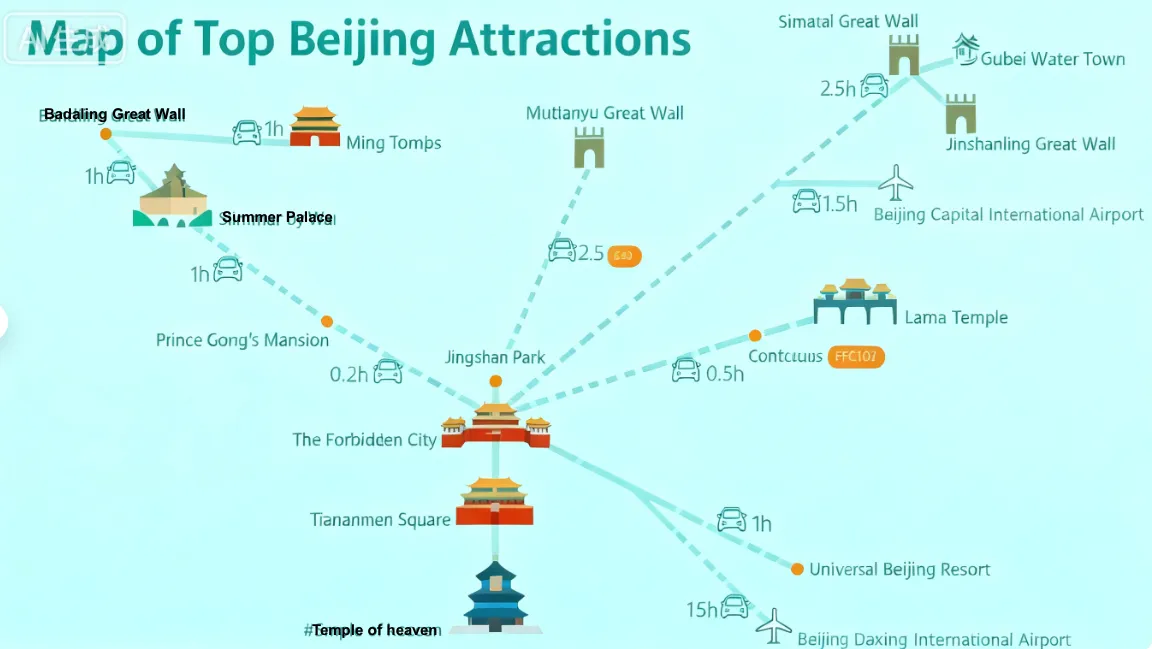
Distances from PEK and PKX to Famous Attractions
Here is a list of the approximate distances from Beijing Capital International Airport (PEK) and Beijing Daxing International Airport (PKX) to some of Beijing's most famous attractions (Great Wall, Forbidden City, Summer Palace and more). Keep in mind that travel times can vary significantly based on traffic conditions, especially during peak hours.
| Attraction | From Beijing Capital International Airport (PEK) | From Beijing Daxing International Airport (PKX) |
| Forbidden City / Tiananmen Square | ~31 km (19 miles) | ~55-56 km (34-35 miles) |
| Temple of Heaven | ~32-33 km (20 miles) | ~55 km (34 miles) |
| Summer Palace | ~35-40 km (22-25 miles) | ~60-70 km (Approximate, further than downtown) |
| Mutianyu Great Wall | ~66 km (41 miles) | ~110-120 km (Approximate, significantly further) |
| Downtown/City Center | ~25-30 km (15.5-19 miles) | ~46-57 km (28.6-35 miles) |
Travel Costs Between Beijing Scenic Spots and Airports
| Scenic Spots | Destination Airport | Transportation Method | Cost (RMB) | Remarks |
|---|---|---|---|---|
| The Palace Museum/Tiananmen Square/Jingshan Park | Beijing Capital International Airport (PEK) | Subway (Transfer to Airport Express) | About 30 | Total journey about 1 hour |
| Taxi | 60-80 | Avoid peak hours, journey time 40-60 minutes | ||
| Beijing Daxing International Airport (PKX) | Subway (Transfer to Daxing Airport Line) | About 45 | Total journey about 1.5 hours | |
| Taxi | 120-150 | Journey time 1-1.5 hours | ||
| Summer Palace/Yuanmingyuan | Beijing Capital International Airport (PEK) | Subway (Transfer to Airport Express) | About 35 | Total journey about 1.2 hours |
| Taxi | 80-100 | Journey time 50-70 minutes | ||
| Beijing Daxing International Airport (PKX) | Subway (Transfer to Daxing Airport Line) | About 50 | Total journey about 1.8 hours | |
| Taxi | 150-180 | Journey time 1.2-1.8 hours | ||
| Badaling Great Wall | Beijing Capital International Airport (PEK) | Subway + Suburban Railway | About 40 | Total journey about 2.5 hours |
| Taxi | 180-220 | Journey time 1.5-2 hours | ||
| Beijing Daxing International Airport (PKX) | Subway + Suburban Railway | About 60 | Total journey about 3.5 hours | |
| Taxi | 300-350 | Journey time 2.5-3 hours | ||
| Mutianyu Great Wall | Beijing Capital International Airport (PEK) | Subway + Bus | About 20 | Total journey about 2 hours |
| Taxi | 100-120 | Journey time about 1 hour | ||
| Beijing Daxing International Airport (PKX) | Subway + Bus | About 50 | Total journey about 3 hours | |
| Taxi | 250-300 | Journey time 2-2.5 hours |
7.Transportation Tips & Insider Advice
-
Currency: Always carry some RMB cash for taxis; not all accept foreign cards.
-
Apps: Download DiDi (ride-hailing app, for rides) and Baidu Maps or Apple Maps with offline mode.
-
Translation: Google Translate or Pleco helps navigate Chinese-only signs.
-
Airport Trains: Both airports connect to Beijing's subway and high-speed rail systems.
8. Frequently Asked Questions (FAQ)
Q1: Is one airport better for the 240-hour Visa-Free Transit policy?
A: Both PEK and PKX are designated ports of entry for the 144-hour Visa-Free Transit program. Your choice should be based on your layover length and where you plan to spend your transit time. Since PEK is closer to the central sightseeing areas, it might be marginally more convenient for shorter transit visits.
Q2: Which airport is closer to the Great Wall of China?
A: PEK (Capital International) is significantly closer to the popular Mutianyu and Badaling sections of the Great Wall. Traveling from PKX to the Great Wall requires crossing the entire city, often taking 2.5 hours or more by car. If the Great Wall is your first destination, PEK is the more practical choice.
Q3: How far apart are PEK and PKX? Is it easy to transfer between them?
A: The two airports are approximately 65 kilometers (40 miles) apart. While there are inter-airport bus services, transferring between them takes a considerable amount of time (at least 90-120 minutes, depending on traffic and waiting times). Plan at least 5–6 hours between connecting flights at different airports. It is highly advised not to book flights arriving at one airport and departing from the other unless you have a very long layover (6+ hours).
Q4: Which airport has better food and shopping options?
A: PEK, having been the main hub for decades, has a vast and established array of international and local dining and luxury shopping, particularly in Terminal 3. PKX features modern, high-quality options, but the total variety is currently less than PEK's established range.
Q5: Which airport is closer to downtown Beijing?
A: PEK is about 30 km away, while PKX is around 46 km. However, PKX’s high-speed rail makes it nearly as fast.
Conclusion: Make an Informed Choice
Whichever you pick, your journey into Beijing will be a world-class experience — one that matches the city's blend of ancient culture and cutting-edge modernity.
While PEK remains the geographically more convenient option for the northern and eastern city heart, PKX offers a truly optimized, futuristic passenger experience. Check your airline, know your final destination, and you will choose the best Beijing airport for a seamless start to your China adventure!