The Quick Answer to China Train Travel
-
High-Speed Rail (G/D/C Trains): The fastest, most modern way to travel (up to 350 km/h). Highly recommended for most tourists. Second Class is incredibly comfortable and the best value.
-
Conventional Trains (Z/T/K Trains): Slower, traditional trains perfect for extreme budget travelers or experiencing a classic overnight Soft Sleeper journey.
-
How to Book: Foreigners can book online via the official 12306 App/Website (English available) or through third-party agents like Trip.com.
-
No Paper Tickets: China is paperless! Your original physical passport is scanned at the turnstiles as your ticket.
China boasts the world's most extensive high-speed rail network and a vast, robust conventional railway system. For any traveler exploring this massive country, utilizing its trains is often the most efficient, cost-effective, and culturally insightful way to traverse long distances. This comprehensive China train travel guide breaks down the two main categories: the modern High-Speed Rail (HSR) and the enduring Conventional (Slower) Trains. Understanding the differences between G/D/C trains and Z/T/K trains is key to planning your perfect journey and navigating the 12306 booking system.
|
Feature |
High-Speed Trains (G/D/C)🚝 |
Conventional Trains (Z/T/K)🚆 |
|---|---|---|
|
Chinese Letter |
G (Gāotiě), D (Dòngchē), C (Chéngjì) |
Z (Zhídá), T (Tèkuài), K (Kuàisù) |
|
Typical Speed |
Fastest (250-350 km/h) |
Slower (80-160 km/h) |
|
Travel Time |
Significantly shorter, ideal for long distances |
Much longer, often overnight |
|
Cost |
More expensive, comparable to budget flights |
Much cheaper, excellent for budget travel |
|
Seats |
Business /1st / 2nd Class |
Hard / Soft Seat, Hard/Soft Sleeper Berth |
|
Punctuality |
Extremely High (Near-perfect reliability, rarely delayed) |
Moderate (Delays are common, especially for long-haul/overnight services) |
|
Comfort/Facilities |
Modern, clean, abundant power outlets, Western and Squat toilets |
Older, basic, scarce power outlets, primarily Squat toilets, communal atmosphere |
The HSR system is China's most significant transportation achievement, known for its speed, punctuality, wide coverage and comfort.
Train Types and Speeds
-
G-Trains (Gāotiě / 高铁, High-Speed Railway): The bullet train or fastest class, operating at speeds 300 - 350 km/h. Typically used for the longest, busiest routes.
-
D-Trains (Dòngchē / 动车EMU Electric Multiple Unit): Electric Multiple Units (EMU), usually running 200 - 250km/h. Often cover shorter high-speed routes or slower sections.
-
C-Trains (Chéngjì / 城际 Intercity EMU Train): Intercity trains, short-distance high-speed services between nearby cities (e.g. Beijing-Tianjin, Guangzhou-Shenzhen).
Ticket Classes and Carriages (Coaches)
HSR features aircraft-style seating, with pricing reflecting comfort and space. All carriages are air-conditioned and non-smoking.
|
English Class |
Chinese Name (Pinyin) |
Seating & Amenities Detail |
|---|---|---|
|
Business Class |
Shāngwù Zuò (商务座) |
The premium luxury option. Features fully reclining, lie-flat seats (1x2 configuration), personal TV screens, complimentary drinks, snacks/meals, and exclusive VIP Lounge Access at major stations. |
|
First Class |
Yīdĕng Zuò (一等座) |
Comfortable, wider seats with generous legroom, 2x2 configuration, often with footrests. Quieter atmosphere than Second Class. |
|
Second Class |
Èrdĕng Zuò (二等座) |
The standard and most common seating, 3x2 configuration. Highly efficient and perfectly suitable for most journeys. Seats recline slightly. |
|
Sleeper (D-Trains) |
Dòngwò (动卧) |
Available on some overnight D-train routes. Typically soft sleeper berths, offering a comfortable, high-speed overnight journey. |
※Business Class
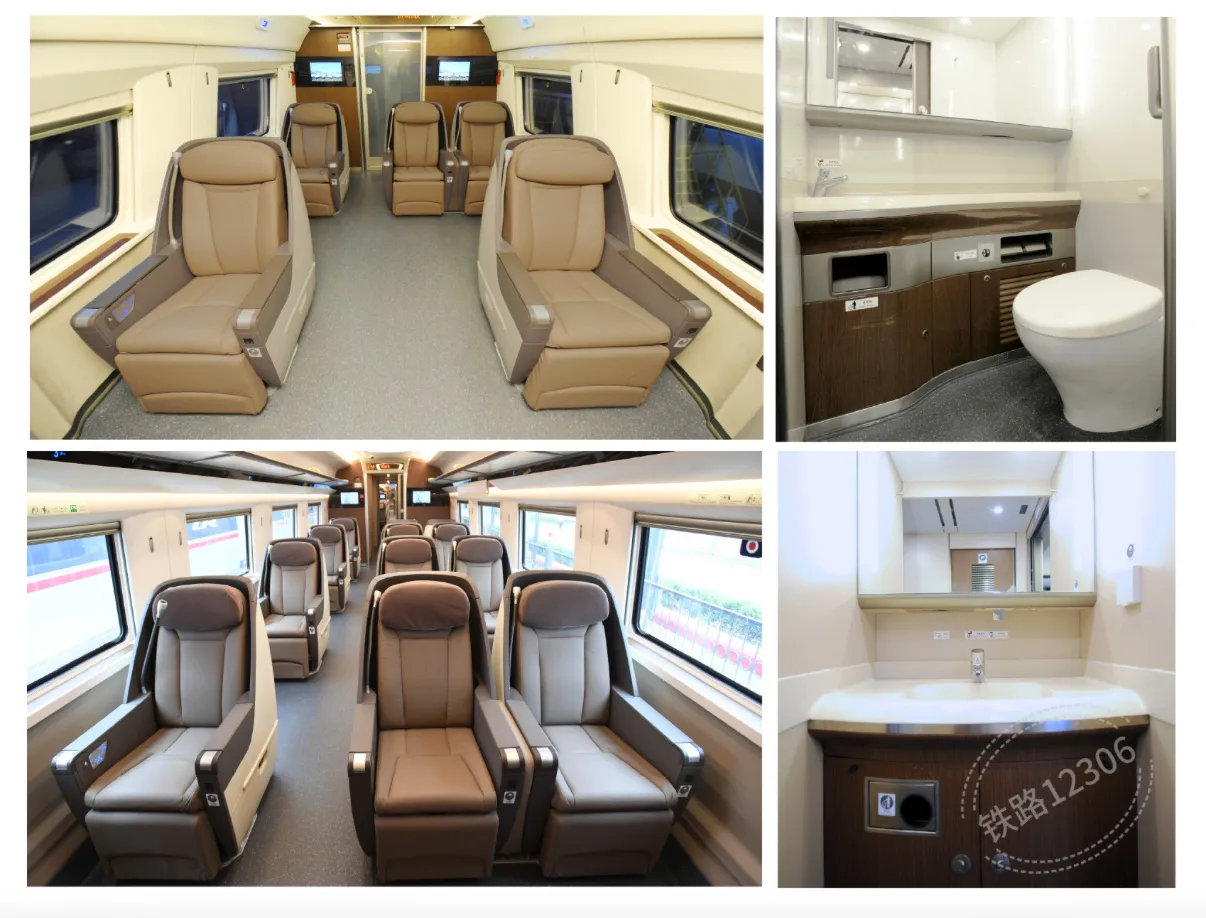
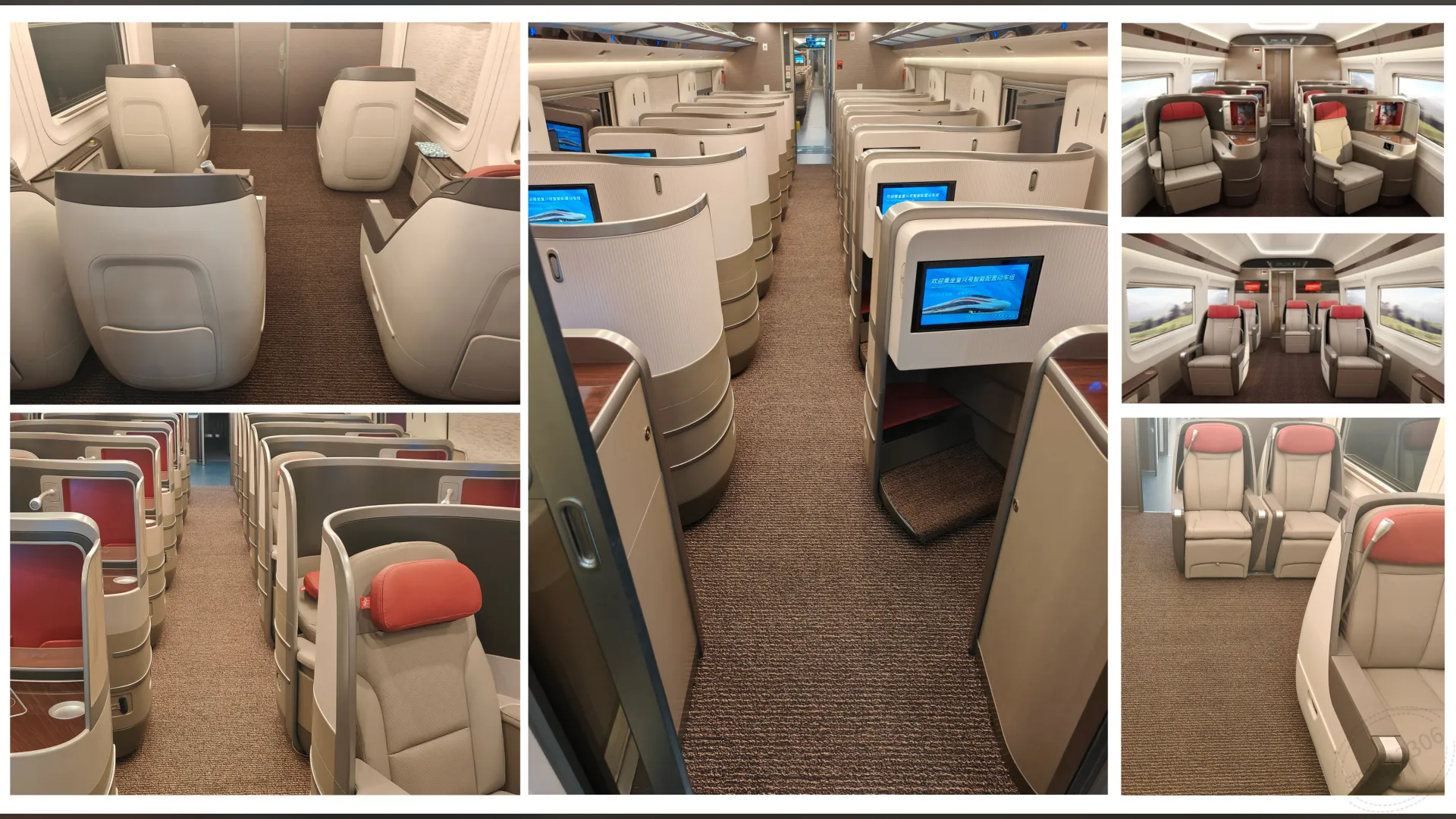
Business Class (Shāngwù Zuò (商务座)) is the most luxurious and comfortable seat option on China’s high-speed trains (mainly G-series and some D-series). It is noticeably better than airline business class on most routes under 8 hours. Automatic sliding doors separate it from other classes.
Seats: most common 2+1 layout (2 seats on one side of the aisle, 1 on the other); some newest trains (CR400AF/BF “Fuxing”): 1+1 layout in certain carriages – only 20–28 seats per carriage, extremely spacious and private. Seat width ≈ 120 cm (47 inches), pitch > 2 meters. Full-grain leather, electric reclining up to 180° (completely flat on Fuxing trains).
Amenities: individual reading light, foldable table, personal power socket (220V) + USB ports
Complimentary services: hot meal (lunch/dinner) or substantial snack box + soft/hot drinks, bottle water, free lounge access at major stations (Beijing South, Shanghai Hongqiao, Guangzhou South, etc.), priority boarding and alighting
Toilets: Most Chinese high-speed trains (especially CR400AF/BF “Fuxing” series and newer CRH380 models) provide at least one dedicated or priority Western-style toilet exclusively or primarily for Business Class passengers.
※First Class
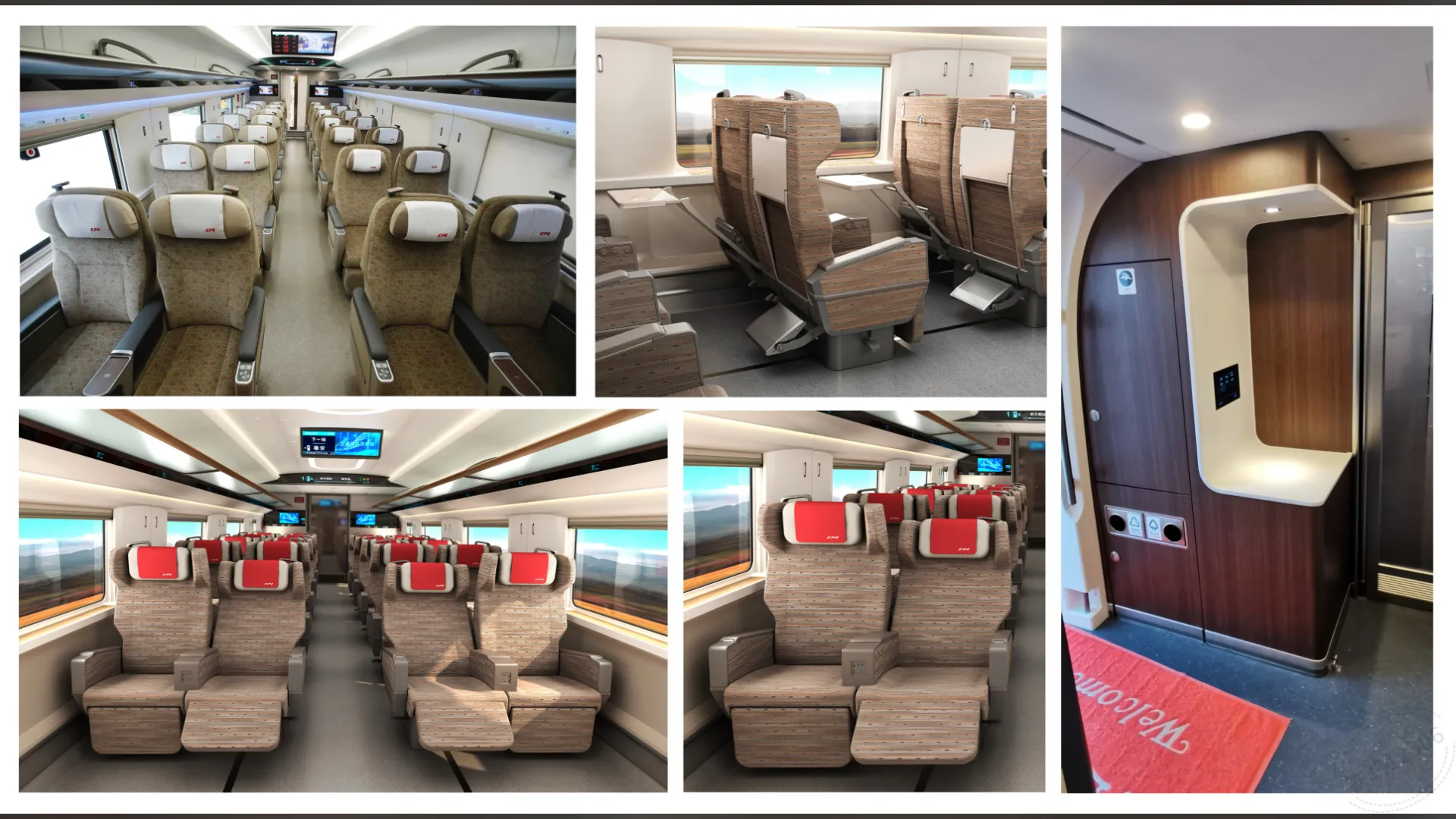
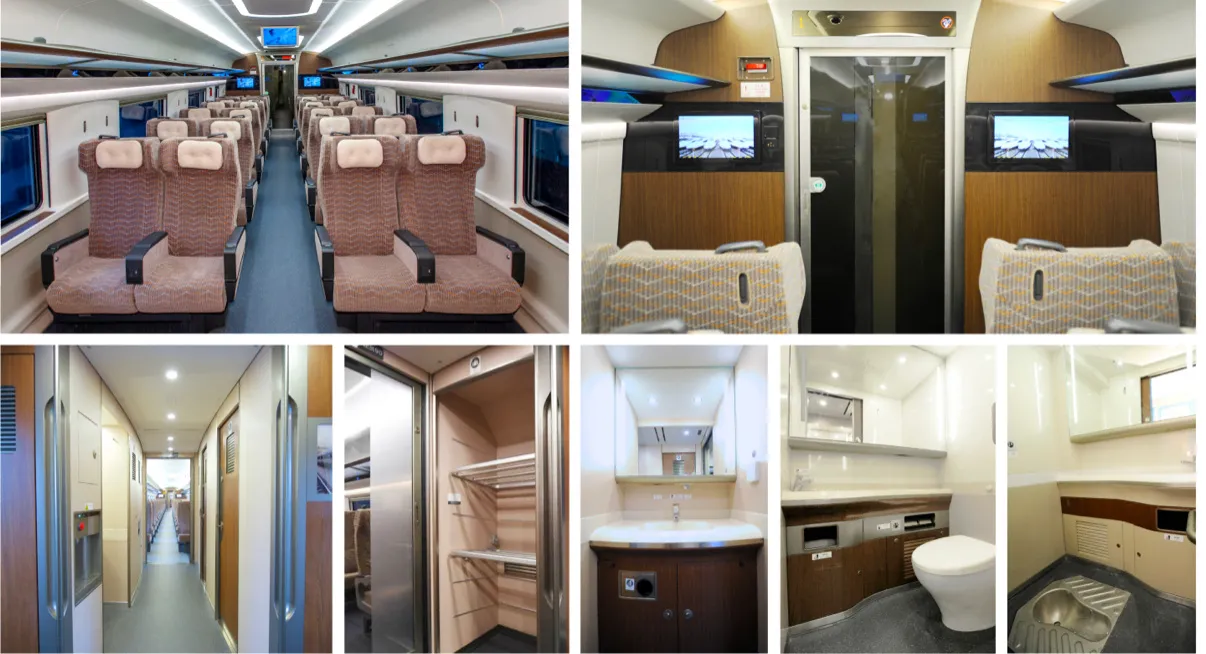

First Class (Yīdĕng Zuò (一等座)) is the comfortable “premium economy” option on nearly all G, D, and C high-speed trains. It strikes the best balance between price and comfort for most travelers — noticeably more spacious than Second Class, yet only 50–80% more expensive. Only 60–70 seats per carriage (vs 90–110 in Second Class) → much quieter.
Seats: 2+2 across (two seats on each side of the aisle) — never the 2+3 crowding of Second Class. Wider and thicker cushioned seats (seat width ≈ 65 cm / 25.5 inches), generous legroom (pitch ≈ 110–115 cm). Recline to about 135° with adjustable headrest and fold-out footrest (on Fuxing trains).
Amenities: fold-down tray table, personal reading light, power socket (220V) + USB port at every seat, seat-back coat hook and small literature pocket. Overhead luggage racks + large space at the ends of the carriage.
Complimentary services: free bottled water (one bottle per passenger, placed on your tray table before departure). On some long-distance G trains (>8 h), a small snack pack may be offered. Priority boarding at major stations. Access to the same regular First/Business Class lounges at big stations (though not the exclusive VIP ones).
Toilets: shared use of the regular (still very clean) Western-style and squat toilets — no dedicated First-Class-only toilet, but they are cleaned more frequently than Second Class ones.
※Second Class
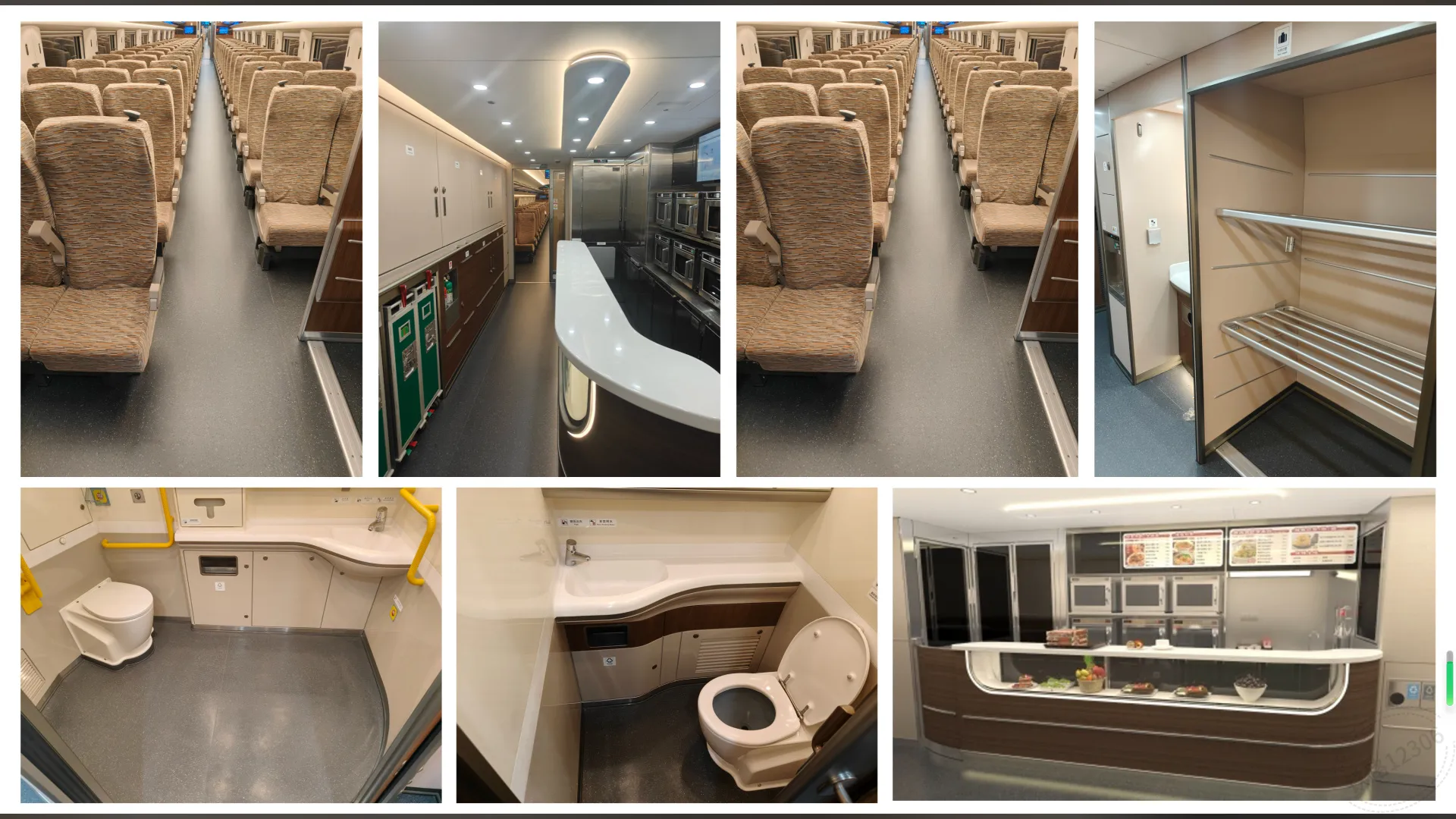
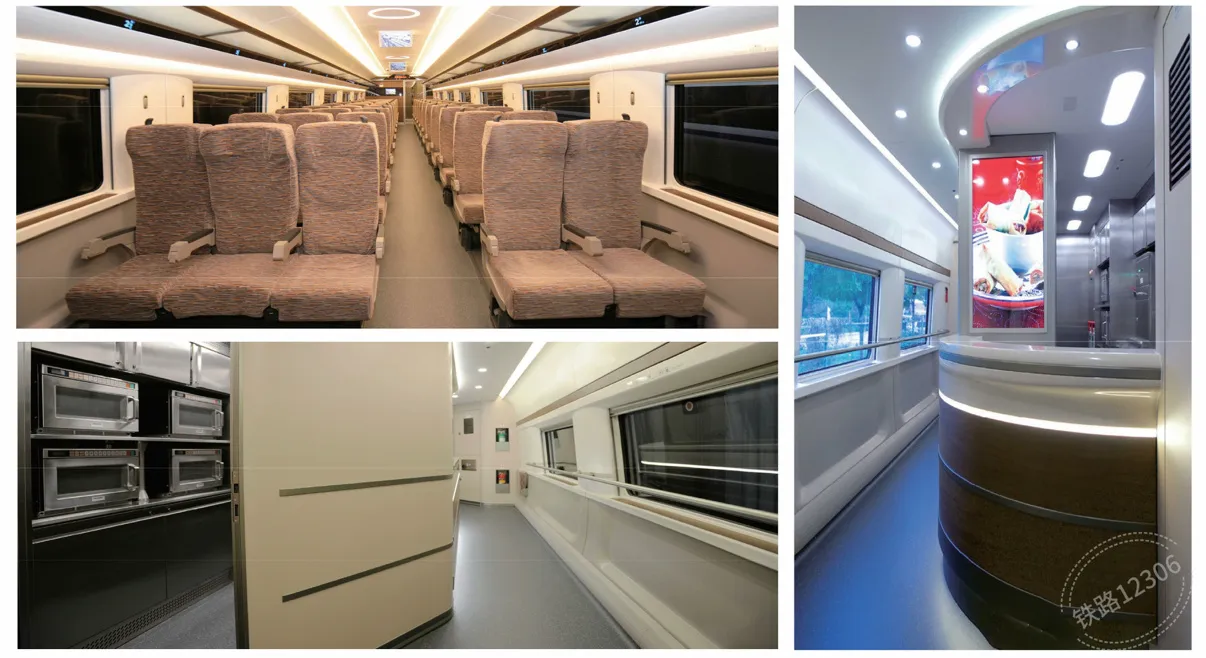

Second Class (Èrdĕng Zuò (二等座)) is the standard and most popular class on all G, D, and C high-speed trains. It is the default choice for 80–90 % of Chinese passengers — and it is much more comfortable than economy class on almost any plane or European train.
Seats: 2+3 across (two seats on one side, three on the other) — the only class with middle seats. Seat width ≈ 48 cm (18.9 inches), comparable to or better than airline economy. Generous pitch ≈ 100–105 cm (more legroom than most airplanes). Reclines ~110° with adjustable headrest.
Amenities: fold-out tray table, personal reading light; power socket (220V) + USB port at every row (shared between seats, but always enough). Huge overhead racks + space between carriage ends for big luggage
Complimentary services: boiling/hot water dispenser at the end of every carriage (bring your own cup noodles or tea — very common).
Toilets: mix of Western-style sit-down and squat toilets (both kept remarkably clean).
A dedicated Dining Car (Cāntīng / 餐听) is available, selling hot meals, snacks, and beverages. Additionally, trolleys pass through the aisles.
💡 The Verdict: Is First Class Worth the Upgrade?
For most travelers, Second Class is more than enough. It offers significantly more legroom than an airplane economy seat and is perfectly comfortable for journeys up to 5 or 6 hours. However, if you are traveling during a major Chinese holiday, have a lot of luggage (First Class has more space at the ends of the carriage), or simply want a quieter environment without the middle seat, the 50-80% price premium for First Class is absolutely worth it.
Popular HSR Routes and Journey Times (Examples)
HSR routes connect all major economic and tourism hubs, making them ideal for both business travel and quick sightseeing trips.
|
Route |
Train Type |
Approximate Time |
Second Class (¥) |
First Class (¥) |
Business Class (¥) |
Primary Purpose |
|---|---|---|---|---|---|---|
|
Beijing ↔ Shanghai |
G-Train |
4.5 to 6 hours |
550 - 600 |
930 - 1000 |
1750 - 1900 |
Business Corridor, Key Tourism |
|
Beijing ↔ Guangzhou/Shenzhen |
G-Train |
8 to 10.5 hours |
800 - 950 |
1280 - 1500 |
2500 - 3000 |
Long-Haul Business, North-South Access |
|
Shanghai ↔ Hong Kong (Kowloon) |
G-Train |
Approx. 8.5 hours |
870 - 900 |
1430 - 1500 |
2700 - 2800 |
International Business/Tourism Gateway |
|
Shanghai ↔ Nanjing |
C-Train |
About 2 hours |
130 - 180 |
260 - 280 |
520-580 |
Regional Intercity (Yangtze River Delta)
|
|
Xi'an ↔ Chengdu |
G/D-Train |
3.5 to 4 hours |
260 - 300 |
420 - 480 |
850 - 950 |
Cultural Tourism, Regional Business |
|
Chengdu ↔ Chongqing |
G/D-Train |
Approx. 1.5 hours |
120 - 160 |
240 - 260 |
450 - 500 |
Intercity Business/Regional |
Conventional trains are ideal for budget travelers, journeys to smaller cities, and those seeking a unique cultural travel experience, particularly on overnight routes. They offer a deep dive into local Chinese life.
Train Types and Speeds
-
Z-Trains (Zhídá / 直达 Direct Express Train): Non-stop Express (fastest of the conventional fleet, running 140-160 km/h).
-
T-Trains (Tèkuài / 特快 Express Train): Special Express (fewer stops than K-trains, approx. 140km/h).
-
K-Trains (Kuàisù / 快速 Fast Train): Fast Train (most stops, approx 120km/h).
Ticket Classes and Carriages
Conventional trains are categorized by seat/berth type.
|
English Class |
Chinese Name (Pinyin) |
Sleeping/Seating Detail & Experience |
|---|---|---|
|
Deluxe Soft Sleeper |
Gāojí Ruănwò (高级软卧) |
The premium conventional sleeper. Features 2 bunks per private compartment, often with an independent washroom/toilet and/or sofa. |
|
Soft Sleeper Berth |
Ruănwò (软卧) |
4 bunks per private compartment with a lockable door. Includes thicker mattresses and more privacy—the best choice for long overnight trips. |
|
Hard Sleeper Berth |
Yìngwò (硬卧) |
6 bunks per open-plan compartment (no door). This is the most popular budget overnight option. Tip: Luggage is stored under the bottom bunk. Note: Bunks are priced (Bottom > Middle > Top) and space/headroom decreases from Bottom to Top. |
|
Hard Seat |
Yìngzuò (硬座) |
Basic, non-reclining seats, often crowded, especially during holidays. Best used only for trips under 4 hours. |
※Deluxe / Luxury Soft Sleeper
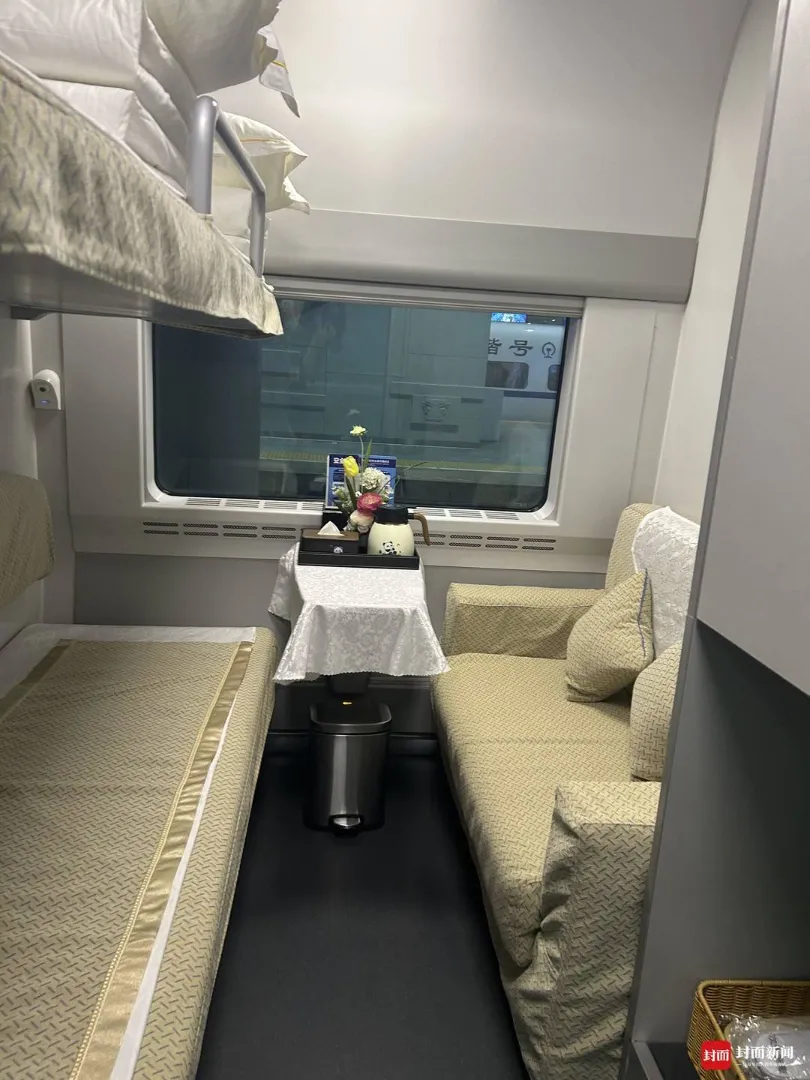
Luxury Soft Sleeper (Gāojí Ruănwò (高级软卧)) is the absolute top class on traditional long-distance Z, T, and some K overnight trains. It is extremely rare — only a handful of flagship routes still have it in 2025 (e.g. Beijing–Shanghai Z51/Z52, Beijing–Hong Kong Z97/Z98, Shanghai–Hong Kong Z99/Z100, Beijing–Urumqi Z69/Z70, etc.). Only 1–2 carriages per train, total capacity usually 20–36 beds.
Compartment layout & beds: Only 2 berths per compartment (upper + lower). Beds - lower berth: ≈ 85–90 cm wide × 195 cm long, upper berth: ≈ 75 cm wide
Amenities: private Western-style toilet & shower room shared by only 3–5 compartments (hot water 24 h). Washbasin with mirror, 220V sockets, clothes hanger, slippers, TV (Chinese channels).
Complimentary services: free bottled water, snacks, seasonal fruit, disposable slippers, toothbrush set. Free meals delivered to your compartment (simple Chinese set meal or sandwich for late departures).
Toilet: private bathroom zone, western-style sit-down toilets.
※Soft Sleeper
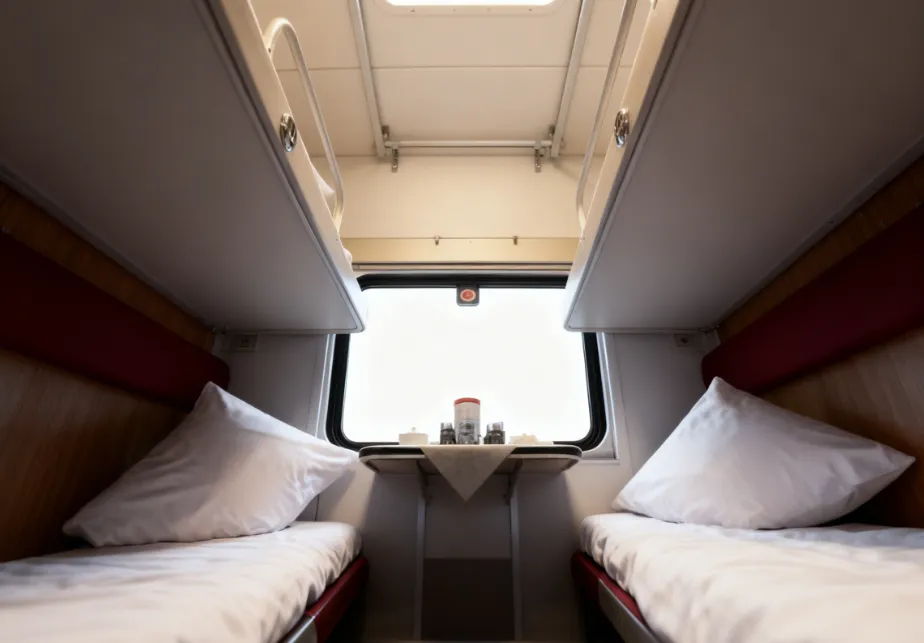
Soft Sleeper (Ruănwò (软卧)) is the classic and still the most comfortable common class on almost all Z, T, and longer K overnight trains. It is the default “good” choice for foreigners and Chinese travelers who want to sleep properly without paying Luxury prices.
Compartment layout & beds: usually 4 berths per compartment (2 lower + 2 upper). Door that closes (but does not lock from inside on most trains) + curtain for extra privacy. Compartments open directly onto the corridor (upper-berth passengers climb a small ladder). Lower berth: ≈ 75–80 cm wide × 190–195 cm; Upper berth: ≈ 70–75 cm wide.
Amenities: power sockets (usually 1–2 per compartment, 220 V), coat hooks, small trash bin
Complimentary services: free hot/boiled water 24 h at the end of each carriage (bring tea or instant noodles)
※Hard Sleeper
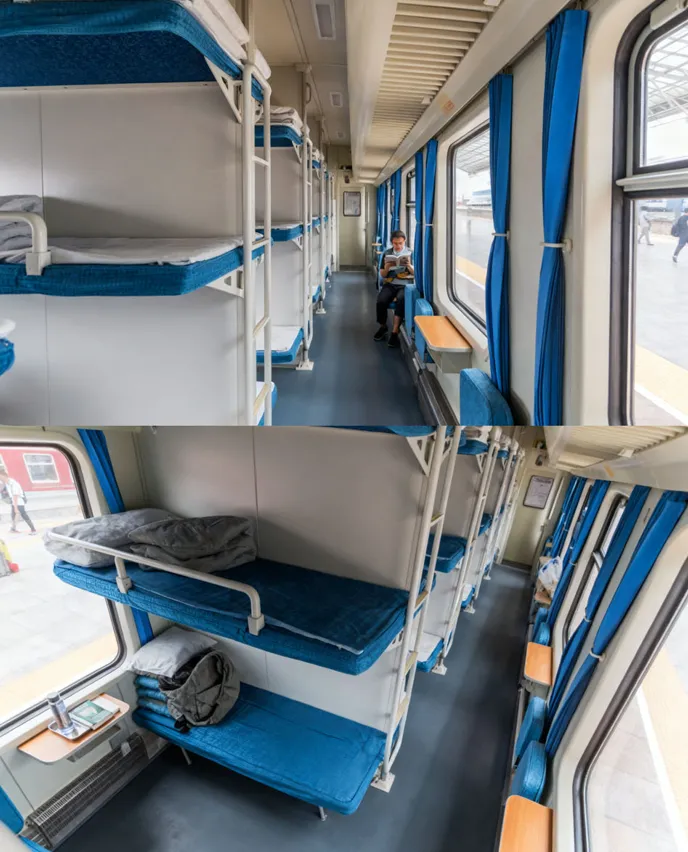
Hard Sleeper (Yìngwò (硬卧)) is the most popular and iconic class on almost all Z, T and ordinary K overnight trains. Despite the name “hard”, the beds are actually padded and most foreigners sleep perfectly well. It is the best value-for-money way to cover huge distances in China.
Compartment layout & beds: open-plan (no door, no wall) – 6 berths per bay (3 tiers: upper, middle, lower).
Amenities: free 24 h boiling water dispenser + thermos at the end of every carriage – Power sockets usually in the corridor or under the small table (bring a short extension cord). Luggage storage: under lower berth, above upper berth, or big racks in the middle of the carriage.
Toilets (shared by the whole carriage): usually 1 Western-style sit-down + 2–3 squat toilets per carriage.
Carriage lights off around 22:00–22:30.
※Hard Seat
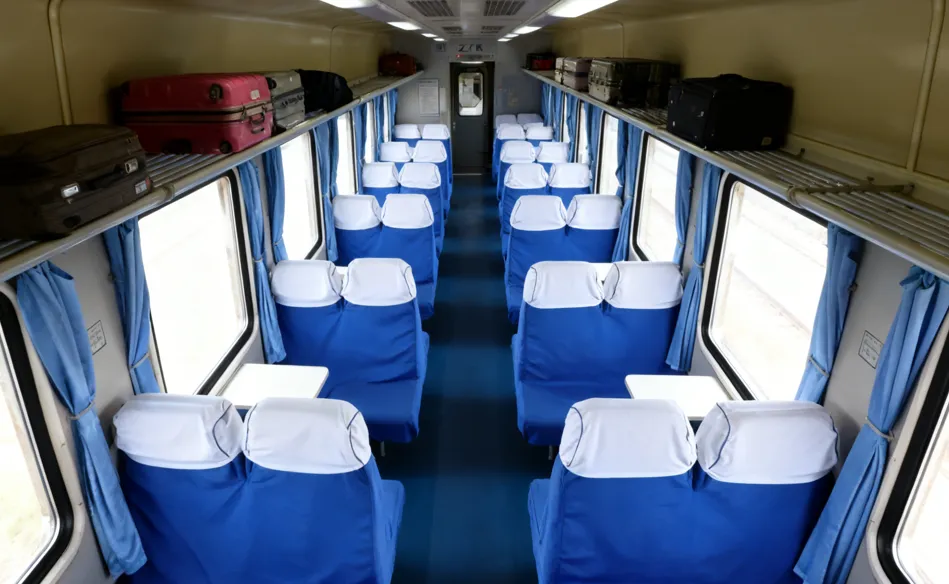
Hard Seat (Yìngzuò (硬座)) is the cheapest and most basic seated class on nearly all Z, T, and ordinary K trains. It is still widely used by locals on journeys from 3 to 24+ hours, but in 2025 it is rarely recommended to foreign tourists unless you are on a very tight budget or seeking the ultimate “raw China” experience.
Seat: 2+3 or 2+2 across (same as high-speed Second Class), but with much less legroom and older padding.Facing groups of seats around small fixed tables in the middle of the carriage (good for cards/eating).
Luggage: Overhead racks + huge space under seats and in the middle racks (you can bring almost anything)
Complimentary services: free 24 h boiling/hot water dispenser at the end of every carriage
Conventional trains primarily feature Squat-style toilets, located at the ends of the carriages. Cleanliness standards can vary significantly, especially on older, long-haul trains. Upper berths have less headroom but are cheapest. Beds: Width ≈ 65–70 cm, length ≈ 185–190 cm (fits most people up to ~1.90 m)
Power Outlets: Power access is often limited to a few shared outlets located near the sinks in the washing area or occasionally in the aisle. Charging electronic devices is challenging, so a power bank is essential.
Dining and Water: A dedicated, often rustic Dining Car (Cāntīng / 餐听) is available, selling basic hot food. However, the most vital amenity is the Boiling Water Dispenser (Hot Water Kettle), available in every carriage, which is constantly used for preparing instant noodles and tea.
Common Traveler Concerns (Overnight Trains)
-
Noise Level: Expect moderate to high noise, especially in Hard Sleeper and Hard Seat carriages, due to constant passenger movement, conversation, and announcements. Soft Sleeper offers significantly better noise insulation due to the closed door.
-
Temperature Control: Trains often run very warm in winter (due to centralized heating) and can be over-cooled in summer. It is advisable to wear layers to adjust to the fluctuating carriage temperature.
-
Hygiene Standards: While staff clean regularly, the overall hygiene standard is lower than HSR. Be prepared for less frequent servicing of the squat toilets, especially on older, long-haul trains. Carrying your own toilet paper and hand sanitizer is highly recommended.
-
Lights-Out Policy (Hard Sleeper): In Hard Sleeper carriages, the main lights are typically turned off around 9:30 PM to 10:00 PM, encouraging passengers to sleep. However, aisle lights usually remain on. In Soft Sleeper, compartment lighting is controlled by the occupants.
Popular Conventional Routes (Examples)
Conventional trains are often the only option for truly remote destinations or for experiencing China's most iconic long-haul routes.
Note: Prices below are approximate starting ranges (CNY) for common services. Actual prices fluctuate based on specific route, distance, and train type.
|
Route |
Train Type |
Approximate Time |
Hard Seat (¥) |
Hard Sleeper (¥) |
Soft Sleeper (¥) |
Primary Purpose |
|---|---|---|---|---|---|---|
|
Xining ↔ Lhasa |
Z/T-Train |
Approx. 21 hours |
225 |
520 |
820 |
Scenic/Tourism (Qinghai-Tibet Railway) - Note: Tibet Permit required. |
|
Beijing ↔ Lhasa |
Z-Train |
Approx. 40 hours |
360 |
820 |
1280 |
Iconic Long-Haul Journey - Note: Tibet Permit required. |
|
Shanghai ↔ Kunming |
K/T-Train |
Approx. 35 hours |
270 |
610 |
950 |
Access to Southwest Tourism Hubs |
|
Kunming ↔ Lijiang/Dali |
K/T-Train |
Approx. 8 to 12 hours |
85 |
180 |
280 |
Scenic/Tourism (Classic Slow Travel) |
|
Harbin ↔ Dalian |
Z/T-Train |
Approx. 10 hours |
105 |
230 |
350 |
Regional/Seasonal Travel (Northeast) |
Where and When to Book
-
Booking Window: Tickets usually go on sale 15 days prior to the departure date. Be prepared to book exactly when sales open for popular routes and holidays.
-
Official Channel: The official platform is 12306.cn (website or app). Note: Foreign users may need a VPN to access the site reliably due to regional restrictions, and a Chinese mobile number is typically required for registration.
-
Third-Party Agents: Trusted platforms like Trip.com offer easier foreign-language booking, with a small service fee.
-
At the Station: Tickets can be purchased at any railway station ticket window using your passport.
Crucial Note for Foreign Travelers: Your Passport is Your E-Ticket
For booking and boarding, your original, valid Passport is mandatory. After booking online, the passport acts as your electronic ticket (E-ticket).
-
ID Verification: Foreign passports must be manually verified at a ticket window or designated manual desk at least once (often before the first use). Automated self-service machines only accept Chinese ID cards.
-
Boarding: You must use your passport for identity verification upon entering the station and for scanning at the boarding gate.
Refund and Alteration Policy
Tickets can usually be refunded or altered (re-scheduled) up to a few hours before departure, subject to varying service fees based on how close to departure you are. The closer to departure, the higher the fee.
Ticket rescheduled:
If change request is more than 48 hours before departure: you can switch to many options (within advance-sale period), usually free of charge (subject to availability).
If within 48 hours before departure: you may only change to another train on the same day of original travel.
After the train has departed: for missed trains, in some cases you can still request change to another train on the same day (before 24:00) — but not always allowed, and depends on the train type and station.
Refund / Cancellation Policy
If you decide not to travel, you can cancel your ticket and get a refund — subject to a sliding fee schedule based on how early you cancel.
| Time Before Scheduled Departure | Refund Fee |
|---|---|
| ≥ ~8 days before departure | No fee (full refund) |
| 48 hours – 8 days before | ~5% of fare |
| 24 – 48 hours before | ~10% of fare |
| Less than 24 hours before | ~20% of fare |
| After train departure | No refund (except in very special circumstances) |
1. Children's Tickets (Értóng Piào / 儿童票)
-
Free (No Ticket): Children under age 6 ride free (max one free child per adult).
-
Child Fare (50% Off): Children between 6 - 12 years old require a discounted Child Ticket (typically 50% of the adult fare).
-
Full Fare: Children over 14 years old must purchase a full-fare adult ticket.
2. Student Tickets (Xuéshēng Piào / 学生票)
-
Eligibility: Student fares are primarily designed for Chinese students enrolled in domestic institutions, requiring a specific student ID card with a verification chip.
-
Discount: Usually 50% off on Hard Seat and Second Class Seat tickets.
-
Note: Short-term foreign travelers or those without a verified Chinese student ID are generally not eligible for student discounts.
The Boarding Process
Chinese railway stations operate similarly to airports, requiring significant time. Be aware of the vast scale of major hubs.
-
Holiday Booking: During major Chinese holidays like Spring Festival (Chūnyùn), National Day (Guóqìng), and May Day, the 15-day pre-sale window is highly competitive. For these periods, be prepared to book tickets exactly when sales open to secure a spot.
-
Station Arrival Time:
-
General: Arrive at least 1 hour before departure, especially at massive hubs (Shanghai Hongqiao, Beijing South) for security and finding your gate.
-
HSR (Minimum): For smaller HSR stations or if you are familiar with the process, you can aim for 30-40 minutes before departure, but this cuts it close. Gates close 5-10 minutes prior.
-
-
Security Check (Anjian): Enter the station via an airport-style security check (X-ray machines).
-
Contraband: Security is strict; do not carry sharp objects, knives, or flammable materials (including most lighters/matches).
-
Liquids & Batteries: Liquids are permitted but may be subject to sampling. Power banks must have a marked capacity (usually below 100Wh) and be carried on your person (not checked luggage).
-
-
ID/Ticket Check & Verification: Scan your Passport at the initial gate/turnstile to enter the main waiting hall, and again at the final boarding gate.
-
Exiting the Station: Upon arrival at your destination, you will need to scan your passport one last time at the exit gate to pass through the turnstiles. Keep your passport readily accessible.
Travel Tips
-
Confusing Station Names: Always double-check your ticket for the precise station name. Major cities often have multiple stations (e.g., Beijing Station is the old station, Beijing West handles conventional trains and some HSR, and Beijing South is a major HSR hub). Getting the station name wrong is a common mistake.
-
Luggage Rules: While there are no official weight limits, space is tight. Size is restricted: The maximum dimension for a single piece of luggage is typically 160 cm (length + width + height) , though this is rarely strictly enforced unless the bag is oversized. The maximum weight is 20kg for adult. Be prepared to manage your own luggage, including lifting it onto the train and into the overhead racks. For Hard Sleeper, large bags often fit under the bottom bunk.
-
Connecting Journeys: Due to the high punctuality of HSR, it is reliable for connecting journeys (e.g., train to flight). However, if relying on a Conventional Train (Z/T/K), allow a significant buffer time (at least 3-4 hours) before a scheduled flight or tight connection due to potential delays.
-
Food and Water: It's recommended to pack your own snacks, especially if you have dietary restrictions. Hot water is always available.
-
Communication: HSR announcements are typically in both Mandarin and English. For communication with staff (attendants wear uniforms), using a translation app is highly recommended.
-
Safety: Keep valuables secure, especially on crowded conventional trains or in Hard Sleeper carriages.
Foreign Traveler Focus: Common Pitfalls
-
12306 Registration & Verification: Registering on the official 12306 App/Website is often difficult due to passport recognition issues. Many foreign travelers use third-party sites like Trip.com for easier booking, even with the small service fee. Crucially, your passport must be manually verified at a ticket window at least once before you can use the e-ticket system for boarding.
-
No Real-Name, No Ticket: China operates a mandatory real-name ticketing system. You absolutely cannot purchase tickets without a valid passport (or other accepted ID) and cannot board if your ID details do not match the ticket.
-
Vast Transfer Distances: Be mindful that major hubs like Shanghai Hongqiao are massive. If you are transferring between two different stations (e.g., from Shanghai Station to Shanghai Hongqiao Railway Station), the taxi or subway ride can take over an hour, requiring careful time management.
Ultimately, the best choice between China's HSR and Conventional trains boils down to balancing time, cost, and experience. Here are our detailed recommendations based on common travel scenarios:
When to Choose High-Speed Rail (HSR)
High-Speed Rail is the clear choice if your priority is efficiency, reliability, and modern comfort.
-
Short to Medium Journeys (Under 4-6 hours): HSR trains (G, D, C) offer superior speed and frequency, making them the most practical choice for day trips or city-to-city hops.
-
Need for Speed and Punctuality: With operating speeds up to 350 km/h and near-perfect punctuality, HSR is ideal for business travelers or those with tight schedules and flight connections.
-
Maximum Comfort and Amenities: For travelers prioritizing space, quiet, and onboard facilities (like abundant power outlets, Western toilets, and premium seating), HSR's Business or First Class options are unmatched.
When to Choose Conventional Trains
Conventional Trains offer a unique blend of affordability and local immersion, best suited for specific travel styles.
-
Long-Haul Overnight Travel (Over 10 hours): The Hard Sleeper and Soft Sleeper options on Z, T, and K trains are highly cost-effective, essentially saving you the cost of a night's accommodation.
-
Tightest Budget: Hard Seat and Hard Sleeper tickets offer the lowest fares available on the railway network, making them the best choice for extreme budget travel. Caution: Hard Seat is generally only recommended for journeys under four hours due to limited comfort and crowded conditions.
-
Cultural Experience and Local Immersion: Conventional trains feature a unique, communal atmosphere. If you wish to travel slowly, meet locals, and experience the classic "train life" of China, these trains provide the perfect setting.
-
Best Privacy Option: The Soft Sleeper class offers four-berth, lockable compartments, giving you privacy and security comparable to an HSR First Class seat (but with a bed).
China's railway network offers unparalleled connectivity and efficiency. Whether you choose the blistering speed and near-perfect punctuality of HSR for major city hops or the unique cultural journey and budget-friendliness of Conventional trains for overnight trips, careful planning using this guide ensures a smooth and memorable ride across the Middle Kingdom.
Related Guide: China Train Luggage Policy;
Best Translation Apps for China
Here are quick answers to the most common practical questions for foreign travelers using China's railway system:
-
Q: Do I need to pick up a physical train ticket?
-
A: No. Your original, valid Passport serves as your electronic ticket (E-ticket). You must present it for all identity checks (entering the station, boarding the train, and exiting the destination station).
-
-
Q: Can I use the automated ticket machines (self-service)?
-
A: No. Automated machines only accept Chinese ID cards. Foreign travelers must use the manual ticket windows or designated service desks for initial passport verification and any necessary assistance.
-
-
Q: When is the best time to book tickets?
-
A: Tickets go on sale 15 days before the departure date. For popular routes or during major holidays (like Spring Festival), you should try to book immediately when sales open.
-
-
Q: How early should I arrive at the station?
-
A: Plan to arrive at least 1 hour before departure. Chinese stations are large, and you need time for security checks, ID verification, and finding the correct boarding gate, which closes 5-10 minutes before departure.
-
-
Q: What are the rules for carrying power banks?
-
A: Power banks must have their capacity clearly marked (usually below 100Wh) and must be carried on your person/in carry-on luggage (not checked).
-