The Quick Verdict
- The Winner: For 90% of travelers, the High-Speed Train (G-Train) is the better choice.
-
Why? While a flight takes 2.5 hours and the train takes 4.5 hours, the door-to-door time is nearly identical once you factor in airport security and travel to the city center. The train offers far more legroom, no luggage fees, free internet/cell service, and is immune to the frequent weather delays that plague Chinese domestic flights.
-
When to Fly: Only fly if you have an immediate international connection at Pudong Airport (PVG) or find an aggressively discounted flash-sale ticket.
Traveling between China’s two most important cities, Beijing and Shanghai, is one of the country's busiest domestic routes. The question every traveler faces is: should I take the high-speed rail or fly?
While flights offer raw speed, China’s modern transportation landscape means the high-speed train (known locally as the G-train) provides an incredibly competitive, reliable, and often superior door-to-door experience.
This ultimate guide breaks down the high-speed rail (HSR) and flight options, comparing total travel time, cost, convenience, and overall journey experience to help you choose the best way to travel from Beijing to Shanghai.
The Quick Comparison Table
| Feature | High-Speed Train | Airplane |
|---|---|---|
| Total Travel Time | 4 - 6 hours | 2 - 3 hours |
| Cost (Economy) | ~¥553 (2nd Class) - ¥1,748 (Business) | ~¥500 - ¥2,000 (varies greatly, + baggage fees) |
| Frequency | Extremely high (every 5-15 mins) | High, but less frequent than trains |
| Stations/Airports | Beijing South / Shanghai Hongqiao (central) | Beijing (Capital/Daxing) / Shanghai (Pudong/Hongqiao) |
| Check-in & Security | 20-30 minutes before departure | 2-3 hours before departure (int'l standards) |
| Onboard Comfort | Spacious, big windows, walkable, stable | Standard aircraft seating, potential turbulence |
| Luggage Allowance | Generous (no weight limit, just size) | Strict weight & size limits (fees apply) |
| Punctuality | Extremely high (>95% on-time) | Prone to delays due to weather & air traffic |
| Scenery & Connectivity | Beautiful countryside views, stable mobile signal | Clouds, spotty connectivity until landing |
⏱️ The "Door-to-Door" Reality Check
A common mistake tourists make is comparing the 4.5-hour train ride to the 2.5-hour flight. However, Beijing South and Shanghai Hongqiao train stations are centrally located and only require arriving 30 minutes early. Conversely, PEK/PKX and PVG airports are far outside the city, require arriving 2 hours early, and are notorious for air traffic delays. In reality, both journeys will take you exactly 5.5 to 6 hours from hotel door to hotel door.
🚄 Option 1: The Beijing-Shanghai High-Speed Rail (G-Train)
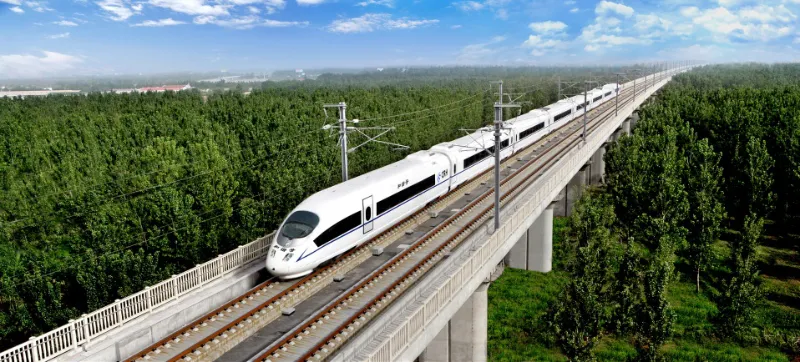
The High-Speed Rail is more than just transport; it's a showcase of Chinese efficiency and comfort. The Beijing-Shanghai High-Speed Railway is one of the most efficient train routes globally, connecting Beijing South Station (北京南站) and Shanghai Hongqiao Station (上海虹桥站). This is often the preferred choice for both domestic and international travelers.
-
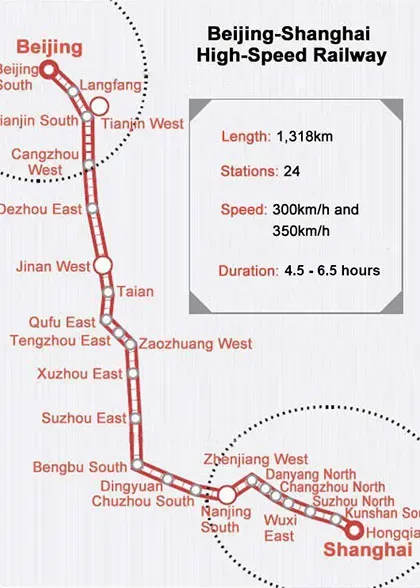
Distance: Approximately 1,318 kilometers (819 miles).
-
Terminals:
-
Beijing: Primarily Beijing South Railway Station (Beijing Nan).
-
Shanghai: Primarily Shanghai Hongqiao Railway Station (Shanghai Hongqiao), which is next to the airport. Some trains also serve the older Shanghai Railway Station.
-
-
Operating Speed: The fastest G-trains, such as the Fuxing Hao (Rejuvenation), operate at speeds up to 350 km/h (217 mph).
-
Travel Time:
-
The fastest "G" trains complete the journey in as little as 4 hours and 18 minutes.
-
Most daytime G-trains take between 4.5 to 6.5 hours.
-
-
Other Key Stops: The line passes through major cities and stops like Tianjin South, Jinan West, Xuzhou East, and Nanjing South.
🎫 Ticket Classes and Estimated Fares (G-Trains)
The G-trains typically offer three main classes of service, which greatly impact the price and comfort.
| Class | Seating Configuration | Key Features | Estimated Price (CNY / USD) |
| Second Class | 3+2 (5 seats per row) | Standard, comfortable seating, most affordable. | ~¥553 - ¥673 |
| First Class | 2+2 (4 seats per row) | Wider, more spacious seating, better recline, footrest. | ~¥930 - ¥1076 |
| Business Class | 2+1 (3 seats per row) | Luxurious, fully reclining seats (can lie flat), meal service, dedicated waiting lounge. | ~¥1873 - ¥2350 |
Please note: Fares are subject to dynamic pricing, train type, and exchange rate, so they can vary.
🌙 Overnight Options
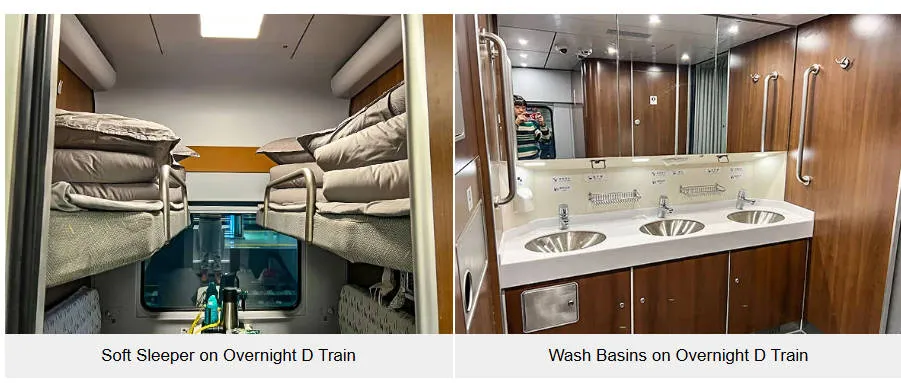
In addition to the daytime G-trains, there are two types of Overnight Sleeper Trains, the high speed D type and the normal type, offering a bed and taking about 12 - 16 hours, saving a night on accommodation.
Approximate Ticket Prices (One-Way)
| Train Type | Class | Price Range (Approx. CNY) |
| D-Series (High-Speed) | 1st Class Sleeper | ¥690 - ¥731 |
| D-Series (High-Speed) | 2nd Class Sleeper | ¥562 - ¥595 |
| Z/T-Series (Normal) | Soft Sleeper | ¥476 - ¥497 |
| Z/T-Series (Normal) | Hard Sleeper | ¥304 - ¥325 |
✅ Pros of the G-Train
| Category | Advantage | Details |
| Punctuality & Reliability | High Punctuality | The G-trains are rarely delayed, providing a near-guarantee of on-time arrival, unlike flights which frequently experience delays in China due to weather or air traffic control. |
| Door-to-Door Time | Better Overall Time |
While the flight time is only ~2.5 hours, the G-Train's station-to-station time of ~4.5 hours results in a similar door-to-door time (train is often even faster) because: • Train stations are typically more central (Beijing South & Shanghai Hongqiao). • Security/Check-in is much quicker (show up 30-40 mins before departure vs. 1.5-2 hours for a flight). |
| Comfort & Space | More Comfortable Seating | Even Second Class seats offer significantly more legroom and are wider than economy class on an airplane. First and Business Class offer exceptional space and full recline. |
| Convenience | Less Hassle with Luggage | No strict weight limits and no need to check bags. You can keep your luggage with you in the overhead racks or dedicated luggage areas at the end of the carriage. |
| Onboard Experience | Freedom & Connectivity | You can use your mobile devices freely, including cell service/data for the entire journey (except short tunnels). You can also walk around and stretch your legs. |
| Scenery | Enjoy the View | The route offers views of the countryside, farmland, and urban landscapes zipping by, which is far more engaging than a cloud view from a plane. |
❌ Cons of the G-Train
| Category | Disadvantage | Details |
| Net Travel Time | Longer On-Board Time | The actual time spent sitting on the train (4.5 to 6.5 hours) is much longer than the flight time (~2.5 hours). |
| Ticket Cost | Can Be More Expensive | While Second Class is usually cheaper than a standard flight, the highly desirable Business Class ticket can be 3-4 times the cost of a Second Class ticket, putting it well above discounted flight prices. |
| Crowding & Noise | Potential for Noise (Second Class) | Second Class cabins can be crowded, especially during holidays, and some travelers have noted that the common practice of using phone speakers for videos can lead to a noisy environment. |
| Booking/Logistics | Specific Logistical Steps for Foreigners | Foreign travelers often need to go to a manual counter to pick up tickets, and automated ticket gates may not work with foreign passports (though this is improving). Limited English is spoken by onboard staff. |
| Food Service | Bring Your Own Food | While food is available for purchase in a dining car and from carts, the selection is often pre-packaged Chinese food and is not usually included in the ticket (unlike some First/Business Class airline fares). |
✈️ Option 2: Flying Between Beijing and Shanghai
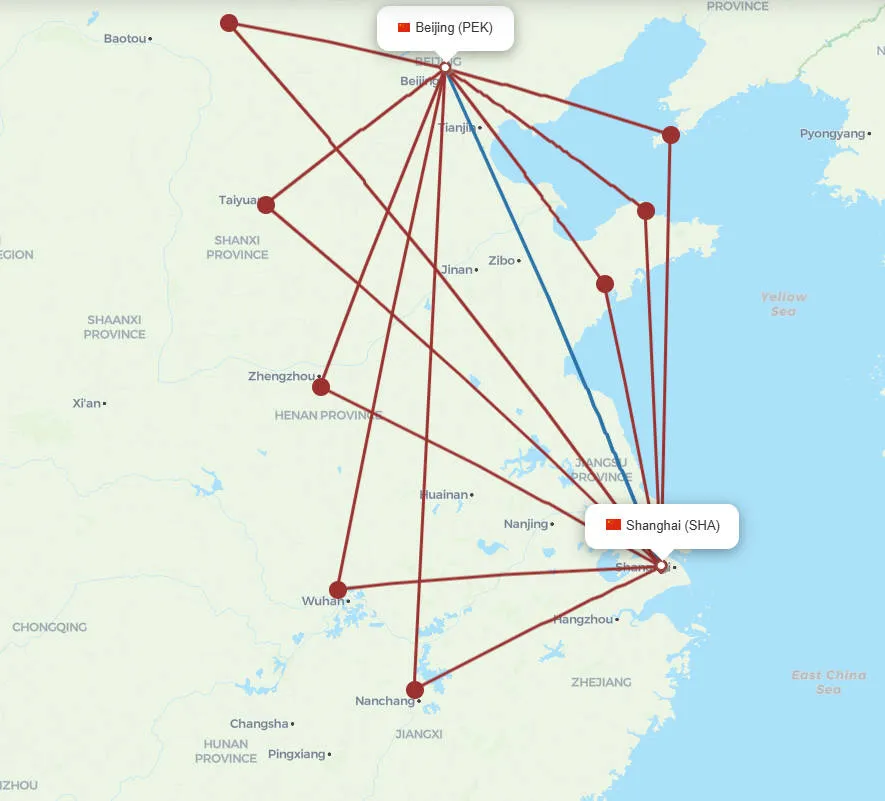
Flying between Beijing and Shanghai is a familiar process for global travelers, but it comes with unique challenges on this route. Flights connect Beijing Capital International (PEK) or Beijing Daxing International (PKX) to Shanghai Pudong (PVG) or Shanghai Hongqiao (SHA).
| Metric | Details |
| Airports |
Beijing: Beijing Capital (PEK) or Beijing Daxing (PKX) Shanghai: Shanghai Hongqiao (SHA) or Shanghai Pudong (PVG) |
| Flight Time | Approximately 2 hours and 5 minutes to 2 hours and 30 minutes (non-stop). |
| Airlines | Major operators include Air China (CA), China Eastern Airlines (MU), Hainan Airlines (HU), and China Southern Airlines (CZ), among others. |
| Distance | The aerial distance is about 1,070 - 1,100 kilometers (665 - 685 miles). |
| Cost | One-way economy prices vary wildly: from as low as ~¥370 - ¥720 for last-minute or highly discounted flights to ¥2000+ for standard fares or travel during peak holidays. |
✅ Pros of Flying
-
Shortest Time in the Air: The actual flight time is significantly shorter (about 2.5 hours vs. 4.5+ hours on the train). This is the key advantage if you can tolerate airport procedures.
-
Best for Pudong (PVG) Destinations: If your final destination is near Pudong International Airport (PVG), flying there directly can be simpler than taking the G-Train to Hongqiao and transferring across the city.
-
Opportunity for Cheap Fares: If you are flexible and book far in advance or find a flash sale, the flight can sometimes be the cheaper option, especially compared to First or Business Class train tickets.
-
Business/First Class Perks: Airline business and first class tickets include better lounge access and dedicated check-in, which streamlines the airport experience.
❌ Cons of Flying
-
Higher Risk of Delays: Flights in China, especially on busy routes like this, are known for being prone to delays due to weather, air traffic control, or military airspace restrictions.
-
Longer Door-to-Door Time: The required check-in time (1.5–2 hours before departure), security lines, and travel time to/from the generally less central airports often negates the shorter flight time.
-
Total Travel Time: Flight time (2.5h) + Airport time (2h) + Transfers (1h+) = ~5.5 to 6 hours total. This is often longer than the fastest G-Train.
-
-
Luggage Restrictions: You must adhere to weight and size limits, and you may need to check bags, adding time to arrival and departure.
-
Less Comfortable Journey: Economy seating is generally more cramped than even Second Class train seating, and you are confined to your seat for the duration of the trip.
When to Choose the Train
The Beijing-Shanghai High-Speed Rail is the recommended default choice for most travelers due to its superior convenience and reliability.
-
You prioritize punctuality: Ideal for tight schedules or connecting to other trains/appointments.
-
You have a lot of luggage: No weight restrictions or handling fees.
-
You are staying near the city center: Avoids costly and time-consuming airport taxi/Maglev rides.
-
You value comfort: The ability to work, relax, or move around the spacious cabin is a major benefit.
When to Choose the Plane
Flights are only genuinely superior in a few scenarios:
-
Connecting to an international flight: If you are arriving at PEK/PKX or departing from PVG/SHA on an international itinerary, flying minimizes the need to leave the secure airport zone.
-
You find an exceptionally cheap ticket: If you can secure a flight dramatically cheaper than the Second Class rail ticket (e.g., less than ¥400 CNY) and are traveling light, the cost savings might outweigh the transfer hassle.
-
You are extremely time-sensitive over long distances: If the journey was significantly longer (e.g., 8+ hours of rail travel), the raw speed of flying would become more relevant.
Booking & Practical Tips
1. Booking the High-Speed Rail
-
Best Platform: Foreign travelers should book via reputable online agents (like Trip.com) or at ticket offices. Booking in advance (up to 15 days) is essential, especially during holidays.
-
Identification: Always use your passport for booking and travel.
-
Station Names: Be careful to select the correct stations: Beijing South (Beijing Nan) to Shanghai Hongqiao (Shanghai Hongqiao).
2. Booking Flights
-
Airports: Shanghai Hongqiao (SHA) is closer to the city center and is often preferred over Shanghai Pudong (PVG) for domestic travel.
-
Check Transfer Time: When comparing prices, always calculate the hidden cost and time of the transfer from PEK/PKX/PVG to your final destination.
While the allure of a quick flight is strong, the reality of traveling between Beijing and Shanghai tells a different story. The high-speed train offers a superior experience in almost every way that matters to a traveler: it’s competitive on total time, more affordable, infinitely more comfortable, and far more convenient.
For the vast majority of visitors and locals alike, the high-speed train is not just the better choice—it’s the best choice. It’s a seamless, comfortable, and impressive showcase of modern Chinese infrastructure that turns a simple transit into a memorable part of your journey.
Frequently Asked Questions (FAQ)
Q1: Is the train cheaper than flying?
A: Usually, yes. Train prices are fixed based on class. However, in low seasons (or for early-morning/late-night flights), airlines offer massive discounts that can make a flight cheaper than a second-class train ticket.
Q2: Can I use my phone and Wi-Fi?
A: Train: You can use your mobile phone freely for calls and data throughout the journey. Most "Fuxing" trains (the newest models) have free Wi-Fi and power outlets at every seat. Plane: Phones must be in flight mode. While some domestic flights now offer Wi-Fi, it is often slow or requires a fee.
Q3: Which has the better view?
A: The train offers a "rolling documentary" of China, passing through the North China Plain, crossing the Yangtze River, and seeing various rural villages. The plane mostly offers clouds until you descend.
Q4: Which option is faster overall, the high-speed train or the plane?
A: The high-speed train may be faster overall when considering the time to get to airports, check-in, security, and baggage claim. The train station is usually more accessible, and the journey starts immediately after boarding.
Q5: Which option is better for business travelers?
A: Business travelers often prefer the high-speed train because of the convenience, comfort, and availability of work-friendly features like Wi-Fi and power outlets. The train also allows easier last-minute bookings and cancellations.
Q6: Are there any scenic views on the Beijing to Shanghai high-speed train route?
A: Yes! The high-speed train route offers scenic views of China's countryside, mountains, and rivers, which can be a more relaxing way to travel.
Related guide: The Ultimate Beijing Metro Guide;