The Quick Answer:PVG (Pudong) vs SHA (Hongqiao)
- Choose PVG (Pudong) if: You are flying long-haul internationally from North America, Europe, or Australia, you want to ride the 300km/h Maglev train, or your main destination is Shanghai Disneyland.
-
Choose SHA (Hongqiao) if: You are flying domestically within China or regionally (Japan/Korea), you prioritize speed and convenience, or you need to transfer directly to a High-Speed Bullet Train to another Chinese city.
Welcome to Shanghai – the dazzling metropolis where futuristic skyscrapers meet ancient temples, and street dumplings are basically a food group! If you're jetting in from abroad, you've probably noticed that it's served by two colossal airports: Shanghai Pudong International Airport (PVG) and Shanghai Hongqiao International Airport (SHA). For first-time foreign visitors, knowing which one to use—and how to navigate the one you land at—is the first step to a smooth trip.
Which one’s “better”? It totally depends on where you’re flying from, where you’re staying, and how much Shanghai traffic you’re ready to battle. This guide breaks down everything you need to know to make the smart choice.
1. Quick Decision Guide: Pudong or Hongqiao?
Shanghai is the financial heart of Asia, and its air traffic reflects that. Before diving into the details, remember the Golden Rule for seamless arrival:
-
PVG (Pudong International): Primarily serves International and Intercontinental flights (Europe, Americas, Australia, major Asian hubs). This is likely where you will land if arriving from outside Asia.
-
SHA (Hongqiao Domestic & Regional): Primarily serves Domestic and Regional flights (e.g., within mainland China, and short-haul routes to Japan, South Korea, Hong Kong, and Taiwan). It is focused on business and efficiency.
PVG and SHA are located on opposite sides of the city. The purpose of this guide is to help you confidently navigate your initial hours in Shanghai, whether you land far east or close to the downtown core.
Key Technical Comparison: PVG vs. SHA
|
Feature |
Pudong International Airport |
Hongqiao International Airport |
|---|---|---|
|
IATA Code |
PVG |
SHA |
|
Location |
Far East of City (Pudong Area) |
West of City (Closer to Puxi Center) |
|
Opened |
1999 (Modern Design) |
1921 (Major Hub, extensively redeveloped) |
|
Terminal Design |
Terminal 1, Terminal 2, and the Satellite Hall (S1+S2) |
Terminal 1, Terminal 2. Compact, Integrated Transport Hub |
|
Walking Time (Gates to Exit) |
Long (Due to size and satellite terminal) |
Moderate (High efficiency) |
|
Typical Airline Alliances |
Mixed (Star Alliance, SkyTeam, Oneworld presence) |
Dominated by China Eastern (SkyTeam) and Domestic Carriers |
II. Shanghai Pudong International Airport (PVG) Deep Dive
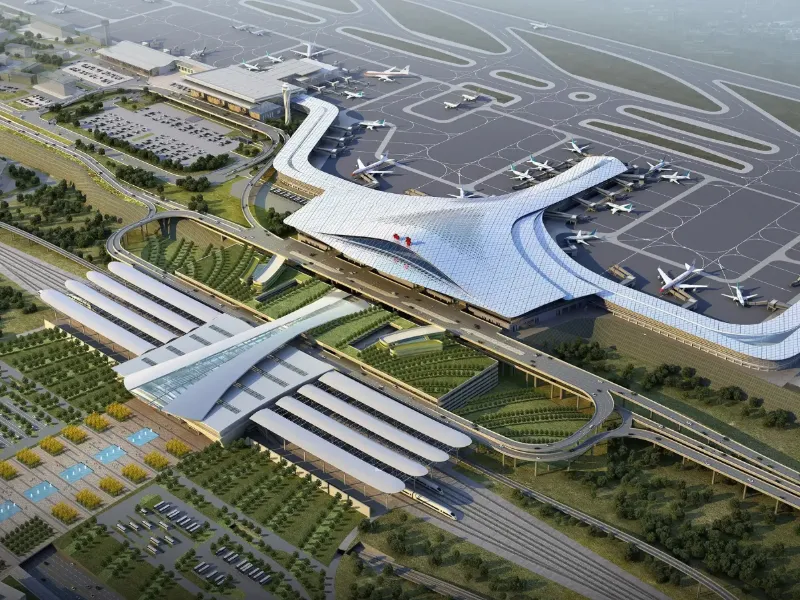
PVG is Shanghai’s main window to the world. It’s located about 40 - 50 kilometers east of the city center (People’s Square / Nanjing Road) in the Pudong New Area.
2.1. Location
PVG is enormous, modern, and often feels like a standard major international hub, characterized by long walking distances and a distinctly global atmosphere. Located in Pudong New Area, close to the coast. To Lujiazui (the skyscraper side of Pudong, still “city center” for many) only ≈ 30–35 km.
2.2. PVG Terminals and Transfers (T1, T2, and Satellite)
PVG operates Terminal 1, Terminal 2, and the Satellite Hall (S1+S2), connected by a free internal shuttle bus and Shanghai Pudong Airport MRT. A massive satellite terminal complex (S1/S2) handles many international gates but generally connects efficiently back to the main terminals for immigration/customs processing. Pay attention to your gate number upon arrival. The shuttle bus between Terminal 1 and Terminal 2 at Pudong Airport operates from 06:00 to 24:00, running every 10 minutes. The airport's MRT system operates 24 hours a day, with trains every 10 minutes from 01:00 to 05:00, and every 5 minutes from 05:00 to 00:59 the next day.
2.3. Airlines & Destinations at PVG
Expect to find most major international carriers here, including Delta, United, Lufthansa, Air France, and Air China's long-haul routes. If your flight crosses an ocean, you're almost certainly arriving at PVG.
T1 Airlines: Vietnam Airlines, Shanghai Airlines, China Airlines, China Eastern Airlines, KLM Royal Dutch Airlines, Air France, Delta Air Lines, etc.
T2 Airlines: Cathay Pacific, American Airlines, Air Canada, ANA All Nippon Airways, Singapore Airlines, British Airways, United Airlines, Air Asia, Lufthansa, China Southern Airlines, Sichuan Airlines, EVA Air, Air New Zealand, Scandinavian (SAS), Swiss, etc. Almost all long-haul flights to Europe, North/South America, Australia, Middle East, Africa.
2.4. Essential PVG Facilities & Connectivity
-
Immigration & Customs: As the primary international gateway, immigration lines can be lengthy, especially during peak travel times.
-
Food & Shopping: World-class duty-free in both terminals + HUGE in the Satellite Hall (Gucci, Chanel, Hermès, plus a giant liquor/tobacco/chocolate wonderland) and a wide array of dining options, though prices are often inflated compared to the city. Cheaper Chinese brands (Xiaomi, Huawei stores) and last-minute souvenirs.
-
Wi-Fi & Connectivity (Crucial Tip!): The airport offers free Wi-Fi, but connecting requires a local Chinese mobile number or, more commonly for foreigners, using a passport scanning kiosk to receive a temporary login credential printout. Look for these kiosks near major entrance points.
-
SIM Card Access: Official kiosks for China Mobile, China Unicom, and China Telecom (for physical SIMs) are typically available after you clear customs and baggage claim. This is the recommended place to secure connectivity if you haven't arranged an eSIM prior to arrival.
-
Lounges: China Eastern “China Lounge” (T1) and No. 77/78/88 lounges (T2/Satellite) – some of the nicest in Asia if you fly business. Priority Pass folks: No. 71 & No. 76 in T2 are excellent (showers, real food, quiet zones).
- Others: 24-hour left luggage (T2 arrivals, ~¥50–100/bag per day). VAT refund counter (T2 international departures, long queues – do it early!). Kids playground. Charging stations. Currency Exchange.
2.5. Transportation to City Center from PVG (Day & Night Options)
(Reference Point: People's Square / East Nanjing Road area)
|
Transportation Method |
Operating hours |
Details |
Estimated Time/Price |
Best For |
|---|---|---|---|---|
|
1. Maglev Train + Metro 🚄 |
Pudong Airport to Longyang Road 07:02 - 21:42. |
Maglev to Longyang Rd (8 mins), then transfer to Metro Line 2. |
Total time: ~40-50 mins. Price: High (RMB 50-80). |
Speed and novelty, avoiding all traffic. |
|
2. Metro (Subway)🚇 |
Panxiang Road · Shanghai National Accounting Institute to Pudong International Airport: 05:25 - 22:42. |
Line 2 directly to People's Square. |
Total time: ~65-80 mins. Price: Cheapest (RMB 7-9). |
Budget travel and efficiency. |
|
3. Taxi / Ride-hailing 🚕 |
24 hours |
Direct transfer to your destination. |
Time: 60-90 mins (depends on traffic). Price: High (RMB 200-250+). |
Convenience, heavy luggage. |
|
4. Airport Bus🚌 |
Airport Line 1 (to Hongqiao Airport/Railway Station): 07:00–23:00 from PVG. Airport Line 2/5/7/8: Typically 07:00/07:30–23:00. Late Night Bus: 23:00 to 5:30 next day |
Several lines to key city districts (e.g., Airport Bus Line 4 to Shanghai Railway Station). |
Time: ~60-90 mins. Price: Low to Moderate. |
Late night/Early morning travel when Metro stops running. |
Night Options (After 10:30 PM): The Maglev train closes down around 21:40 PM and the metro line 2 closes down around 22:30 PM. If you arrive after this time, you must rely on Night Bus Routes (specific airport shuttle lines run much later, connecting PVG to major city hubs) and 24/7 Taxi / Ride-hailing (expect potential late-night surcharges and long queues).
2.6. The Shanghai Maglev Train (SMT) Experience
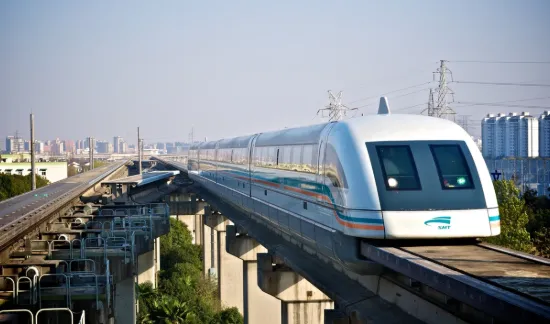
The Shanghai Maglev Train is the world's fastest commercially operating train, reaching speeds up to 300 km/h (186 mph).
-
Journey: The train connects PVG to Longyang Road Station (in Pudong). Your ride takes you from the airport to downtown Shanghai in 8 minutes covering 30 km (18.6 miles).
-
Pricing: Regular ticket one-way RMB 50 yuan, round-trip RMB 80 yuan; VIP ticket one-way RMB 100 yuan, round-trip RMB 160 yuan.
-
Transfer: The Maglev does not go to the city center. At Longyang Road, you must transfer to Metro Line 2 or Line 7 to continue your journey into the city.
-
Key Consideration: The Maglev's operating hours typically end around 9:40 PM.
III. Shanghai Hongqiao International Airport (SHA) Deep Dive
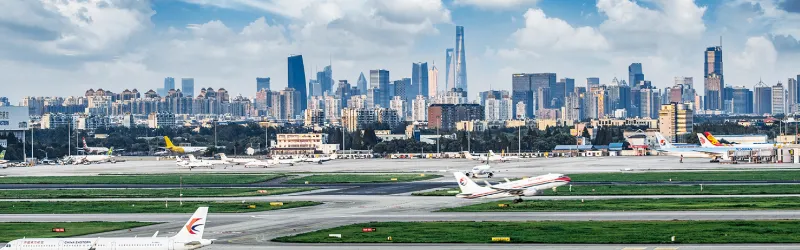
Hongqiao is all about convenience and domestic dominance, located only about 13 kilometers (8 miles) west of the central Puxi area. It's only about 15 kilometers from Hongqiao Airport to People's Square/Nanjing Road.
3.1. Location & Vibe
SHA feels more efficient and integrated than PVG, owing to its proximity to the city and its direct connection to the massive Hongqiao High-Speed Railway Station (one of China's largest transport hubs). Fly in, grab bubble tea, hop on a bullet train to Hangzhou in 15 minutes.
3.2. SHA Terminals (T1 and T2)
-
T1: Handles older facilities and primarily serves regional international flights (like budget carriers or flights to neighboring countries).
-
T2: The modern, main terminal, handling the vast majority of domestic flights and major Chinese carriers.
If you transfer flights, confirm your terminal. The distance between T1 and T2 is approximately 6.5 kilometers. The T1 and T2 terminals are connected by the Metro Line 10 (one stop) or a free airport shuttle bus.
3.3. Airlines & Destinations at SHA
Primarily hosts domestic carriers like China Eastern, Air China, and Shanghai Airlines flying to cities across China, as well as short-haul flights to hubs like Tokyo, Seoul, and Taipei.
Terminal 1: China Eastern Airlines, Air China, Air Macau, Korean Air, EVA Air, Cathay Pacific, Hong Kong Airlines, All Nippon Airways, Spring Airlines, Shanghai Airlines, etc.
Terminal 2: China Eastern Airlines, China Southern Airlines, Air China, Shandong Airlines, etc.
3.4. SHA Facilities & Hongqiao Transportation Hub
-
Connectivity: The true strength of SHA is its integration with the Hongqiao Transportation Hub. You can seamlessly move from the terminal to the Metro or High-Speed Rail network.
-
Wi-Fi & Connectivity: Similar to PVG, free Wi-Fi is available, requiring verification via passport scan or a Chinese mobile number. SIM/eSIM purchase locations are available, but the focus is often less international than PVG.
- Others: Charging points. Luggage Storage. Currency Exchange. Departure Tax Refund.
-
Food & Shopping: Due to its integration with the adjacent Hongqiao Railway Station, SHA offers a broader and more practical range of dining options (including fast food, cafes, and local cuisine) that cater to high-volume domestic traffic. Retail shopping is available but less focused on high-end international duty-free than PVG.
-
Lounges: SHA provides a standard selection of airline and third-party lounges (Priority Pass, DragonPass, etc.), primarily supporting the high volume of domestic business travelers and SkyTeam/China Eastern frequent flyers.
3.5. Transportation to City Center from SHA (Day & Night Options)
(Reference Point: People's Square / East Nanjing Road area)
|
Transportation Method |
Operating hours |
Details |
Estimated Time/Price |
Best For |
|---|---|---|---|---|
|
1. Metro (Subway)🚇 |
Line 2: Panxiang Road · Shanghai National Accounting Institute to Pudong International Airport: 05:25 - 22:42. Line 10: Hangzhong Road to Hongqiao Railway: 05:30 - 22:25 (Sunday to Thursday), 05:30 - 23:50 (Friday - Saturday) Jilong Road to Hongqiao Railway: 05:25 - 22:30 (Sunday to Thursday), 05:25 - 22:30 (Friday - Saturday) |
Terminal 1 is served by metro line 10. |
Total time: ~30-40 mins. Price: Cheapest (RMB 4-6). |
Budget travel and efficiency. |
|
2. Taxi / Ride-hailing🚕 |
24 hours |
Direct transfer to your destination. |
Time: 30-45 mins (depends on traffic). Price: Moderate (RMB 80-120+). |
Convenience, heavy luggage, late night travel. |
|
3. Airport Bus🚌 |
Airport Line 1 06:00 - 23:00, Line 941 05:30 - 23:00; |
Several lines available to key districts. |
Time: Varies. Price: Low to Moderate. |
Late night/Early morning travel when Metro stops running. |
Night Options (After 10:30 PM): The Metro also closes around 10:30 PM. Alternatives are similar: Late-Night Bus Line 316 (23:00 - 05:00) connections and 24/7 Taxi/Ride-hailing. Given SHA's proximity to Puxi, a late-night taxi ride is generally shorter and less expensive than one from PVG.
IV. Inter-Airport Transfer: PVG ⇔ SHA Connectivity
If you are transferring between an international arrival at PVG and a domestic connection at SHA (or vice versa), time management is paramount.
-
The Fastest Route (Recommended): Use the dedicated Airport Link Line (机场联络线), a direct suburban rail connection that bypasses city traffic.
-
Time: Approx. 40 minutes
-
Price: Moderate (RMB 26).
-
Frequency: Check operating hours (typically 6:00 AM - 10:00 PM).
-
-
The Cheapest Route: Metro Line 2. Direct, but painfully slow. Time: ~90-100 minutes.
-
Taxi/Private Transfer: Time: ~50-70 minutes (can vary greatly with traffic). Price: Highest (RMB 200-250+).
-
Critical Tip: Recommended Transit Time: Always budget a minimum of 4-5 hours for inter-airport connections. This accounts for potential flight delays, lengthy immigration/customs queues, luggage retrieval, and unexpected traffic or shuttle delays.
💡 Pro Tip: The New Airport Link Line (机场联络线)
For years, transferring between PVG and SHA required a grueling 90-minute subway ride across the entire city. Now, the dedicated Airport Link Line acts as an express suburban railway that connects the two airports directly in just 40 minutes! If you have a connecting flight, skip the standard Metro Line 2 and follow the airport signs specifically for the "Airport Link Line".
V. Distances to Famous Shanghai Attractions
Your choice of airport will significantly impact your travel time and cost, depending on your final destination. Here is a comparison of key attractions relative to both PVG and SHA.
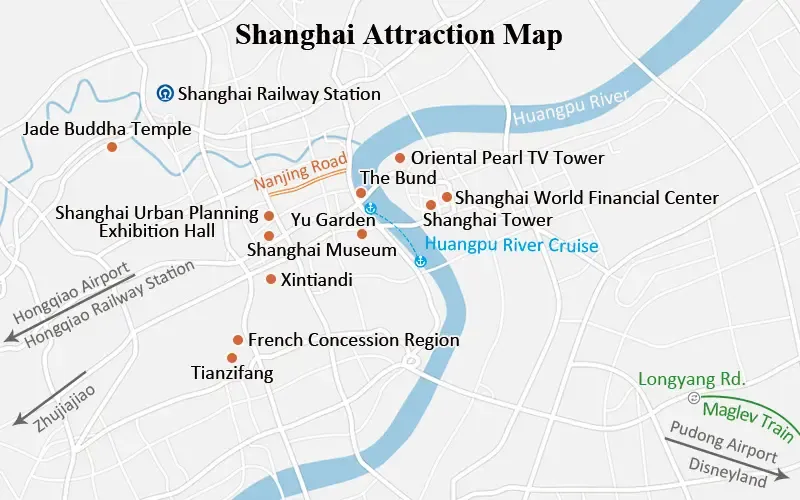
5.1. Travel Time and Distance to Key Attractions
|
Destination |
PVG (Pudong) Travel Time (Approx.) |
PVG Distance |
SHA (Hongqiao) Travel Time (Approx.) |
SHA Distance |
|---|---|---|---|---|
|
Central Puxi (The Bund / People's Square) |
60–90 minutes |
45 km (28 mi) |
30–45 minutes |
15 km (9 mi) |
|
Wukang Road (Former French Concession) |
70–100 minutes |
48 km (30 mi) |
35–50 minutes |
18 km (11 mi) |
|
Lujiazui Financial District |
50–70 minutes |
40 km (25 mi) |
40–60 minutes |
20 km (12 mi) |
|
Shanghai Disneyland |
30–40 minutes |
25 km (16 mi) |
60–90 minutes |
45 km (28 mi) |
|
Oriental Pearl Tower (东方明珠) |
50–70 minutes |
39 km (24 mi) |
40–55 minutes |
15 km (9 mi) |
|
Yu Garden (豫园) |
65–95 minutes |
41 km (25 mi) |
35–50 minutes |
17 km (11 mi) |
|
Tian Zi Fang (田子坊) |
60–90 minutes |
42 km (26 mi) |
30–45 minutes |
14 km (9 mi) |
5.2. Estimated Travel Costs (Public Transit vs. Taxi)
Costs are estimates and subject to traffic, time of day, and specific destination within the area.
|
Scenic Spots |
Airport |
Transportation Method |
Cost (RMB) |
Remarks |
|---|---|---|---|---|
|
Central Puxi (The Bund / People's Square)
|
PVG
|
Public Transit |
7–57 |
Time: ~40-80 mins. Metro only (RMB 7-9) or Maglev + Metro (RMB 57). |
|
Taxi / Ride-Hailing |
200–250+ |
Time: 60-90 mins. Long distance, acceptable during off-peak. |
||
|
SHA
|
Public Transit |
4–6 |
Time: 30-40 mins. Metro Line 2 or 10 direct to city center |
|
|
Taxi / Ride-Hailing |
80–120+ |
Time: 30-45 mins Preferred fast and convenient, highly recommended. |
||
|
Wukang Road (Former French Concession)
|
PVG
|
Public Transit |
7–57 |
Time: 70-100 mins Metro only (RMB 7-9) or Maglev + Metro (RMB 57). |
|
Taxi / Ride-Hailing |
220–280+ |
Time: 70-100 mins. Longer distance to central Puxi area |
||
|
SHA
|
Public Transit |
4–7 |
Time: 35-50 mins. Efficient lines, requires transfer. |
|
|
Taxi / Ride-Hailing |
90–130+ |
Time: 35-50 mins. Close to city center, reasonable taxi fare. |
||
|
Lujiazui Financial District
|
PVG
|
Public Transit |
7–57 |
Time: 50-70 mins. Lujiazui is in Pudong, PVG's district. |
|
Taxi / Ride-Hailing |
180–230+ |
Time: 50-70 mins. Closer than Puxi, but still requires crossing the river. |
||
|
SHA
|
Public Transit |
4–6 |
Time: 40-60 mins. Direct via Metro Line 2. |
|
|
Taxi / Ride-Hailing |
100–150+ |
Time: 40-60 mins. Requires crossing the Huangpu River, which affects time. |
||
|
Oriental Pearl Tower
|
PVG
|
Public Transit |
7–57 |
Time: 50-70 mins. Located in Lujiazui, same as above. |
|
Taxi / Ride-Hailing |
180–230+ |
Time: 50-70 mins. Shorter distance, taxi is preferred. |
||
|
SHA
|
Public Transit |
4–6 |
Time: 40-55 mins. Direct via Metro Line 2. |
|
|
Taxi / Ride-Hailing |
90–140+ |
Time: 40-55 mins. Requires crossing the Huangpu River tunnel. |
||
|
Yu Garden
|
PVG
|
Public Transit |
7–57 |
Time: 65-95 mins. Requires multiple transfers, Maglev + Metro is recommended. |
|
Taxi / Ride-Hailing |
200–250+ |
Time: 65-95 mins. Long distance, higher taxi fare. |
||
|
SHA
|
Public Transit |
4–6 |
Time: 35-50 mins. Metro Line 10 is direct, very convenient. |
|
|
Taxi / Ride-Hailing |
80–120+ |
Time: 35-50 mins. Preferred close to city center, fast. |
||
|
Tian Zi Fang
|
PVG
|
Public Transit |
7–57 |
Time: 60-90 mins Requires transfers, time consuming. |
|
Taxi / Ride-Hailing |
200–250+ |
Time: 60-90 mins Long distance, not recommended unless late night. |
||
|
SHA
|
Public Transit |
4–6 |
Time: 35-50 mins. Metro Line 10 is accessible, efficient and fast. |
|
|
Taxi / Ride-Hailing |
70–110+ |
Time: 30-45 mins. Preferred close to city center, lowest cost. |
||
|
Shanghai Disneyland
|
PVG
|
Public Transit |
7–9 |
Time: 30-40 mins. Metro Line 2 to 11. |
|
Taxi / Ride-Hailing |
100–150+ |
Time: 30-40 mins. Preferred shortest distance and time. |
||
|
SHA
|
Public Transit |
9–11 |
Time: 60-90 mins. Many metro lines, very time consuming. |
|
|
Taxi / Ride-Hailing |
250–300+ |
Time: 60-90 mins. Farthest distance, highest cost. |
VI. Airport Accommodation: PVG vs. SHA Hotels
-
PVG Area (Pudong): Best suited for essential overnight layovers between long-haul flights. Options are generally standard airport hotels or mid-range lodging in the nearby town of Chuansha. Choose this if you are heading to Disneyland the next day.
-
SHA Area (Hongqiao): Offers superior accommodation integrated directly into the transport hub and the bustling Hongqiao Business District. This is the better choice if you have an early morning domestic or regional connection.
VII. Immediate Arrival Essentials: Payment, Visa & Customs
Getting connected, ready to pay, and navigating immigration is critical immediately upon landing in Shanghai.
A. Digital Payment Setup (Crucial for Daily Life)
Shanghai operates primarily as a cashless society. While some venues accept international cards, you will need a digital wallet for taxis, small shops, and local vendors.
-
Alipay/WeChat Pay: Both apps allow you to link international cards (Visa, Mastercard, etc.) immediately after securing airport Wi-Fi. It is highly recommended to do this before leaving the airport to ensure seamless travel and payment acceptance throughout the city.
B. 240-Hour Visa-Free Transit
If you are passing through Shanghai to a third country (or region like Hong Kong/Macau), you may be eligible for a transit stay without a formal visa.
-
Eligibility Check: Verify your citizenship and itinerary requirements beforehand.
-
Immigration & Customs: Both airports support 240-hour visa-free transit for citizens of 50+ countries, including the US, UK, Canada, Australia, and most of the EU.
VIII. Recommendations for Different Travelers
To make your decision even easier, here is a breakdown of which airport is best for your specific travel profile, assuming your flight destination is flexible:
8.1. The Business Traveler (Time is Money)
-
Priority: Speed, efficiency, and proximity to major business districts (Lujiazui, People's Square).
-
Recommendation: SHA (Hongqiao). It offers the shortest, most predictable travel time to the core Puxi business districts via Metro Line 2/10 or a fast taxi ride, minimizing time spent in transit.
8.2. The Budget Traveler (Cost is Key)
-
Priority: Lowest transportation cost and most reliable public transit access.
-
Recommendation: SHA (Hongqiao). The Metro ride from SHA to the city center is inexpensive (RMB 4-6) and only takes 35-45 minutes. PVG's budget option is cheaper overall but involves a significantly longer ride (~65-80 minutes).
8.3. The Shanghai Tourist (Attraction-Focused)
-
Destination: Central Puxi (The Bund, French Concession, Yu Garden): SHA (Hongqiao). The proximity and direct Metro access make SHA the clear winner for tourists focused on the western side of the city.
-
Destination: Disneyland / Pudong: PVG (Pudong). Since Disneyland is located in the Pudong district, PVG is the optimal choice, requiring the shortest travel time (30-40 minutes) and the lowest taxi/Metro cost to the resort area.
8.4. The Transit Passenger (Connecting Flights)
-
Priority: Minimal risk of missing a connection.
-
Intra-Airport Transfer (PVG ⇔ SHA): Use the Airport Link Line (机场联络线) and budget a minimum of 4-5 hours for the entire process. The choice of arrival airport is secondary to the need for ample buffer time.
-
Stay in Shanghai: If you have an overnight stop, staying near SHA/Hongqiao Hub is better for convenience and access to more varied accommodation options if your next flight is early morning.
IX. Frequently Asked Questions (FAQ)
Q: Can I use a credit card easily in Shanghai?
A: While major hotels and large department stores accept international credit cards (Visa, Mastercard), Shanghai operates heavily as a cashless society. For taxis, small shops, and local vendors, you must use a digital payment app. We strongly recommend setting up Alipay or WeChat Pay by linking your international credit card immediately upon securing airport Wi-Fi.
Q: Which airport is better for first-time travelers to Shanghai?
A: If you are flying internationally, Pudong Airport (PVG) is usually better.
Q: What is the latest time I can take the Metro or Maglev?
A: Both the Maglev train (from PVG) and the Metro lines (from both PVG and SHA) generally close down around 10:30 PM. If you arrive later than this, you must rely on Airport Night Bus routes or 24/7 Taxis/Ride-hailing services.
Q: Is 4 hours enough time to transfer between PVG and SHA?
A: The guide recommends budgeting a minimum of 4-5 hours for inter-airport connections. While the dedicated Airport Link Line only takes about 40 minutes, you must account for potential flight delays, immigration queues, luggage retrieval, and the time needed to navigate the large terminals.
Q: Which airport is better for reaching the High-Speed Rail (HSR)?
A: SHA (Hongqiao) is directly integrated with the massive Hongqiao High-Speed Railway Station. You can transition seamlessly by foot from the terminal to the HSR network, making it the superior choice for onward travel to cities like Hangzhou, Suzhou, or Nanjing.
Q: Do both airports have free Wi-Fi?
A: Yes. You can access free Wi-Fi in both PVG and SHA, but you may need to scan your passport to get a login code.
IX. Conclusion: Quick Decision Guide
10.1. Summary Table: PVG vs. SHA at a Glance
|
Feature |
PVG (Pudong International) |
SHA (Hongqiao Domestic) |
Winner/Context |
|---|---|---|---|
|
Fastest to City Center |
Maglev + Metro (~40 mins) |
Metro Line 2/10 (~30-45 mins) |
SHA wins on consistency. Maglev is faster but requires transfer. |
|
Cheapest Fee |
Metro (RMB 7-9) |
Metro (RMB 4-6) |
SHA (Lower Metro fare and overall cost). |
|
Most Convenient (Taxis) |
Long Ride (RMB 200+) |
Short Ride (RMB 80-120+) |
SHA (Closer proximity, less expensive). |
|
Best Suited For |
International Travelers, Disneyland Visitors, Maglev Experience Seekers |
Domestic Travelers, Business/Budget Travelers, Puxi-Central Tourists |
Varies (Based on itinerary). |
|
Unique Feature |
Shanghai Maglev Train, Primary Global Gateway (Long-Haul) |
Integrated High-Speed Rail (HSR) Hub, Unmatched City Proximity |
Both (Maglev is a unique ride; HSR integration is highly functional). |
10.2. Transportation Tips & Insider Advice
The choice of Shanghai airport is often dictated by your flight origin. When flexibility exists, the decision rests entirely on your itinerary and travel priorities: PVG serves as the primary international gateway, offering the unique Maglev experience and proximity to Pudong/Disneyland; conversely, SHA is the superior choice for domestic, business, and budget travelers seeking unparalleled speed and convenience to central Puxi.
Maglev Ticket Discount: When purchasing the Maglev ticket, show your same-day boarding pass (paper or electronic) to reduce the one-way fare from RMB 50 to RMB 40. This is a simple but often forgotten way to save money.
Ultimate Wi-Fi Access Method: If your foreign mobile number cannot receive the airport Wi-Fi verification code, look for the Passport Scanning Kiosk. After scanning your passport information, the machine will print a small slip with a Wi-Fi account and password. This is the most reliable way for foreigners to connect to the airport network.
Avoid Peak Hour Cross-River Traffic: If you need to travel between Pudong (PVG side) and Puxi (SHA side), try to avoid peak hours from 7:30 AM–9:30 AM and 5:00 PM–7:00 PM. Taxis and private cars crossing the Huangpu River tunnels or bridges can face serious delays.
Ultimately, your choice between PVG and SHA is the first successful step in navigating Shanghai. PVG proudly serves as the city's primary international gateway, offering the thrilling speed of the Maglev; conversely, SHA is the functional champion, prized by domestic and business travelers for its close proximity and unmatched integration with the Puxi downtown core and the High-Speed Rail network. By understanding these key distinctions, you are now well-equipped to choose the airport that best aligns with your travel style and ensure a smooth, efficient start to your Shanghai journey!