Navigating China's sprawling transport hubs can be a daunting task for first-time visitors. However, China has spent the last decade building some of the most integrated transport systems in the world. In most major cities like Beijing, Shanghai, Guangzhou, and Shenzhen, the transition from a high-speed train to the local subway (often searched as a China train to subway transfer) is designed to be seamless—if you know what to look for.
This comprehensive guide will walk you through the entire process, ensuring you move from your train seat to the metro carriage like a pro.
⚡ Quick Transfer Summary:
-
Do not exit the station: Follow the green "Metro" (地铁) signs leading underground to stay in the fast-track zone.
-
Skip the second security check: Use the "Security-Free" transfer corridors available at major hubs.
-
Use digital payment: Generate an Alipay or WeChat Transport QR Code to scan directly at the turnstiles.
-
Know your carriage: Sit in carriages 5 through 10 to be closest to the downward escalators.
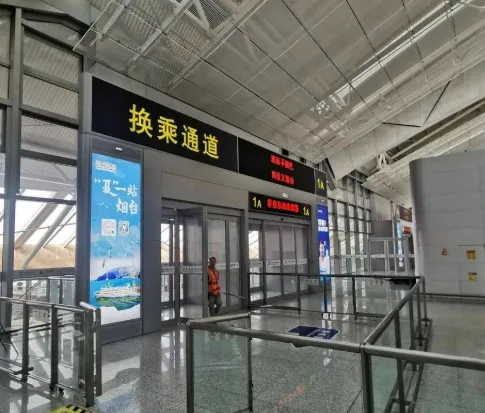
I. Understanding China’s Train-to-Metro System
China’s "Train-to-Metro" integration is a cornerstone of its modern infrastructure, designed to move millions of people between high-speed rail (HSR) hubs and city centers with surgical precision.
In 2026, this system has evolved into a "seamless" experience, where the physical and digital boundaries between national rail and local subways are increasingly blurred.
1. The Core Philosophy: "Zero-Distance" Transfer
The goal of major Chinese transport hubs (like Shanghai Hongqiao, Beijing South, and Chongqing East) is a "zero-distance" transfer.
-
Vertical Integration: High-speed platforms are usually on the upper levels, while metro lines run directly underneath the same building.
-
One-Stop Hubs: A single station can serve as a confluence for 5+ high-speed lines and 3–5 metro lines simultaneously.
-
No Exit/Re-entry: In many newer "integrated" stations, you do not have to leave the station building or go through a second security check to move from the train to the subway.
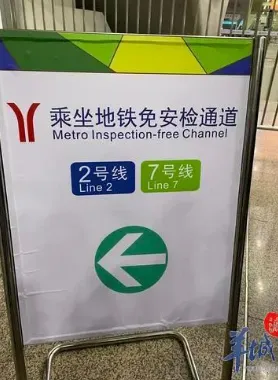
2. Integrated Security (The "Security-Free" Transfer)
One of the biggest pain points in Chinese travel used to be "double security"—scanning bags for the train and then again for the metro.
-
Unidirectional Trust: Many major cities (including Beijing, Shanghai, and Chengdu) have implemented "Security-Free Transfers" ($安检互认$).
-
How it works: Once you step off a high-speed train, you stay within a "sterile zone." You can follow the green "Metro" signs and swipe directly into the subway gates without putting your bags through a second X-ray machine.
-
Note: This usually only works from Train ➔ Metro. If you are going Metro ➔ Train, you will almost always undergo a secondary, more rigorous railway security check due to stricter national regulations.
3. Digital Connectivity & Payment
By 2026, the "One Ticket" concept has largely shifted from physical tickets to digital "All-in-One" codes.
-
Super Apps: You no longer need local transit cards. Apps like Alipay and WeChat Pay have "Transport" mini-programs that work in almost every city.
-
Intercity Codes: Many regions (like the Yangtze River Delta) now use a unified QR code that works for both the Shanghai Metro and the high-speed intercity trains to neighboring cities like Suzhou or Hangzhou.
-
NFC & International Cards: International travelers can now "tap-and-ride" with Visa or Mastercard at metro gates in Tier-1 cities or link these cards to local transit apps for a seamless experience.
4. Automation and Efficiency
-
Wayfinding: Stations use high-tech digital signage that updates in real-time. If a metro line is congested, the signage in the train arrival hall may redirect you to an alternative line or bus.
-
Robotic Assistance: You will frequently see AI kiosks and roaming robots in arrival halls that can scan your train ticket and show you a map of exactly which metro exit leads to your hotel.
-
Frequency: During peak hours, metro trains in cities like Shenzhen or Guangzhou run every 90 to 120 seconds, ensuring that a train-load of 1,000+ passengers is cleared from the platform almost instantly.
Comparison of Transfer Experiences
| Feature | Old System (Pre-2020) | Modern Integrated System (2026) |
| Security | Double Check (Train & Metro) | Single Check (Mutual Recognition) |
| Navigation | Static signs, often confusing | Real-time digital maps & AI kiosks |
| Payment | Cash or local physical cards | Unified QR codes & International NFC |
| Transfer Time | 15–30 minutes | 5–10 minutes |
Pro Tip: If you are arriving at a massive station like Guangzhou South or Beijing Daxing, look for the "Transfer" (换乘) signs immediately upon exiting the train platform. Do not follow the "Exit" (出站) signs unless you plan on taking a taxi; exiting the building often forces you to go back through security to reach the metro.
II. Preparation Before Your Trip
To ensure your journey through China’s high-speed rail and metro network is as smooth as possible, a little digital "heavy lifting" before you leave home is essential. By 2026, the physical paper ticket is virtually extinct; your smartphone is your passport, ticket, and wallet.
1. The "Big Three" Essential Apps
You should download and set up these apps at least a week before departure to verify your identity.
-
Alipay (or WeChat): These are non-negotiable.
-
Setup: Link your international credit card (Visa/Mastercard) to the "Wallet" or "Cards" section.
-
Transport Code: Inside Alipay, find the "Transport" icon. You can switch cities (e.g., from Shanghai to Beijing) to generate the specific QR code needed for the local metro.
-
-
12306 (Official Railway App): This is the only official source for train tickets.
-
Verification: You must register with your passport number. It can take a few hours for the system to verify your identity.
-
English Version: There is now a robust English interface (look for "English" in the settings or during the initial login).
-
-
Amap (Gaode) or Baidu Maps: While Google Maps works with a VPN, it is often outdated. These local apps provide lane-by-lane navigation and tell you exactly which metro carriage is closest to your transfer elevator.
- The Absolute Must-Have Apps for China Transportation introduces the must-have transportation apps for foreigners in China, helping you navigate every aspect of travel
2. Document Readiness
China has moved to an Electronic Ticket system. Your "ticket" is tied directly to your passport number.
-
Passport as Ticket: When entering the train station, you simply scan your passport at the automated gates (or the manual lane). You do not need to print anything.
-
Photo of Passport: Keep a high-quality photo of your passport and visa on your phone. If you lose your physical passport, this can help you verify your identity at station police booths.
3. Connectivity: Staying Online
The Train-to-Metro system relies heavily on live QR codes. If your phone dies or has no data, you are essentially stranded at the gate.
-
Travel eSIM: Purchase an eSIM (like Airalo or Nomad) that includes a built-in VPN/roaming so you can still access Western apps.
-
Power Bank: High-speed trains have power outlets ($220V$ or USB-C), but metro stations often do not. Carry a portable charger to ensure your QR code is always ready.
Pre-Departure Checklist
| Task | Timing | Why it matters |
| Verify 12306 Account | 7 Days Prior | Avoids "Identity Not Verified" errors at the station. |
| Link International Card | 5 Days Prior | Ensures your payment method is active for metro taps. |
| Download Offline Maps | 2 Days Prior | Essential if you lose signal in deep underground metro lines. |
| Check Station Names | 1 Day Prior | Ensure you know if you're going to Beijing South or Beijing West—they are far apart! |
A Note on "The Great Firewall"
If you are using a local Chinese SIM card, you won't be able to access Google, Instagram, or WhatsApp without a VPN. However, if you use a roaming SIM from your home country or a travel eSIM, you can usually bypass these restrictions automatically.
III. Step-by-Step: How to Transfer from Train to Metro in China
Moving from a high-speed train to the city’s metro network is arguably the most efficient part of the Chinese travel experience. In 2026, most major hubs have perfected the "Arrival-to-Aisle" flow, allowing you to go from your train seat to a subway carriage in under 10 minutes.
Here is the step-by-step breakdown of how to navigate this transition like a local.
Step 1: Follow the "Metro" Signs (地铁)
The moment you step off your high-speed train, look up. You will see large signs in both Chinese and English.
-
The Keyword: Look for Metro or the Chinese characters 地铁 (Dìtiě).
-
The Direction: In 90% of Chinese stations, the metro is located in the Basement (Level B1 or B2). Follow the arrows toward the escalators leading down.
-
Avoid the "Exit" Trap: Do not follow signs that say "Exit" ($出站$) if they lead toward the surface/taxis. In many stations, if you exit the main building, you will have to go through a second security check to get back into the metro.
Step 2: The "Security-Free" Zone
As of 2026, major hubs (like Shanghai Hongqiao, Beijing South, and Shenzhen North) use Security-Free Transfers for arriving rail passengers.
-
Stay Inside: As long as you stay within the designated transfer corridor, you won't need to put your bags through an X-ray again.
-
The Gate: You will eventually reach a row of subway turnstiles. This is where the "Train Zone" ends and the "Metro Zone" begins.
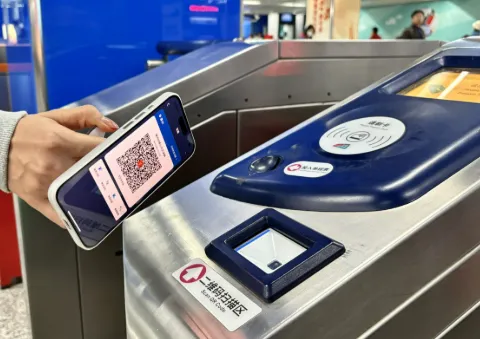
Step 3: Scaning into the Metro
Forget paper tickets. Your phone is your pass.
-
Open Alipay: Tap the Transport ($出行$) icon on the home screen.
-
Select "Metro": Ensure the city at the top matches where you are (e.g., "Shanghai").
-
Generate Code: If it's your first time in that city, you may need to click "Activate" (a one-second process).
- Scan: Hold your QR code over the scanner on the turnstile. The gates will open instantly.
Step 4: Finding Your Platform
Chinese metro stations are massive but highly organized.
-
Color Coding: Every line is color-coded (e.g., Line 2 is always light green in Shanghai).
-
Directional Signs: Look for the "Terminal Station" listed on the signs to ensure you are on the correct side of the platform.
-
Carriage Placement: Look at the platform floor; it often shows where the doors will open and which end of the train is closer to the exit/transfer you need at your destination.
Comparison: Train to Metro vs. Metro to Train
| Direction | Security Check? | Ticket/ID Needed |
| Train ➔ Metro | Usually No (at major hubs) | Metro QR Code (Alipay/WeChat) |
| Metro ➔ Train | Yes (Strict Railway Security) | Passport (scanned at gate) |
Troubleshooting Common Issues
-
The QR Code won't scan: Increase your phone's brightness to 100% and hold the phone about 5–10 cm above the glass scanner.
-
"Identity Not Verified": If Alipay asks for verification, you may need to upload a quick photo of your passport. It’s best to do this while still on the high-speed train using the free Wi-Fi.
-
Battery is Dead: Look for "Power Bank Rental" stations (like Jiedian or Meituan) near the station exits. You can rent a charger for a few yuan.
IV. City-Specific Guides
1. Beijing: The Grand Axis
Main Hub: Beijing South (Běijīng Nán)
-
The Lines:
-
Line 4 (Teal): The tourist workhorse. Connects you to Xuanwumen (transfer for Forbidden City) and the Summer Palace.
-
Line 14 (Pink): The business route. Connects to the Guomao CBD and the chic Chaoyang Park area.
-
-
The Trick: Beijing South is circular. If the Line 4 ticket gates are swamped, walk to the opposite side of the arrival hall to the Line 14 gates; they are often much quieter.
- The Ultimate Beijing Metro Guide provides you with everything you need: from the best ways to pay to navigating the crucial Airport Express lines.
2. Shanghai: The High-Speed Gateway
Main Hub: Shanghai Hongqiao railway station to metro transfer (Hóngqiáo Zhàn)
-
The Lines:
-
Line 2 (Light Green): Direct to People's Square, The Bund, and Pudong Airport (PVG).
-
Line 10 (Lavender): Reaches Xintiandi, Yuyuan Garden, and the French Concession.
-
-
The Trick: If you are heading to the city center, Line 10 is often faster despite having more stops because the platforms at Hongqiao are closer to the train arrival gates than Line 2's.
- The Ultimate Shanghai Metro Guide is a must-read information for first-time visitors to Shanghai who plan to travel by subway.
3. Guangzhou & Shenzhen: The Greater Bay Area
Guangzhou South (Guǎngzhōu Nán):
-
Key Line: Line 22 (Amber) is an "Express" line. It is significantly faster than the older Line 2 for reaching the southern business districts.
-
Note: This station has a very efficient "one-way exempt security" system at Exits C, E, and G. Follow these specifically to skip the X-ray lines.
- Guangzhou Metro Guide help visitors to buy tickets, read maps and travel around Guangzhou by subway.
Shenzhen North (Shēnzhèn Běi):
-
Key Line: Line 4 (Red) connects directly to the Futian Checkpoint, allowing you to be in Hong Kong within 45 minutes of leaving your high-speed train.
-
Layout: Unlike most stations, the metro platforms here are above ground. You will take a series of massive escalators up from the arrival hall.
4. Chengdu & Xi’an: The Western Hubs
Chengdu East (Chéngdū Dōng):
-
Key Line: Line 2 (Orange) goes straight to Tianfu Square (the heart of the city).
-
Innovations: By 2026, Chengdu East is a leader in biometric transfers. If you’ve registered your passport on the "Chengdu Metro" app, you can use the "Face Scan" lanes for a completely hands-free entry.
- Chengdu Metro Guide show you all Chengdu lines and how to go famous attractions.
Xi’an North (Xī’ān Běi):
-
Key Line: Line 2 (Red) is your primary route to the Bell Tower and the Ancient City Walls.
-
Airport Link: The Airport Intercity Railway (Line 14) also departs from here, taking you to the airport in about 35 minutes.
-
The Trick: Xi'an North has two separate arrival squares (North and South). Most metro entrances are in the South Square (Basement).
Comparison of Transit Hub Layouts
| City | Primary Metro Level | Unique Feature |
| Beijing | Basement (B1/B2) | Strict ID checks even for metro entry. |
| Shanghai | Basement (B1) | Direct 90-min metro link between two airports. |
| Guangzhou | Ground Floor/B1 | Highly optimized "Security-Free" corridors. |
| Shenzhen | Elevated (F4/F5) | Seamless high-speed link to Hong Kong. |
| Chengdu | Basement (B2) | Face-recognition gates for registered travelers. |
V. Tips and Tricks for a Smooth Transfer
To make your train-to-metro transfer as seamless as possible in 2026, here are the "insider" tips that differentiate a seasoned traveler from a stressed one.
1. Master the "Alipay Transport Widget"
By 2026, you don't need to dig through menus.
-
The Shortcut: Once you are in a major city, Alipay often detects your location and provides an Alipay transport QR code for foreigners right on your lock screen or at the very top of the app.
-
Pro Tip: Screenshot your QR code only as a last resort. Most gates require a "live" refreshing code for security, so ensure your data/eSIM is active before you reach the turnstile.
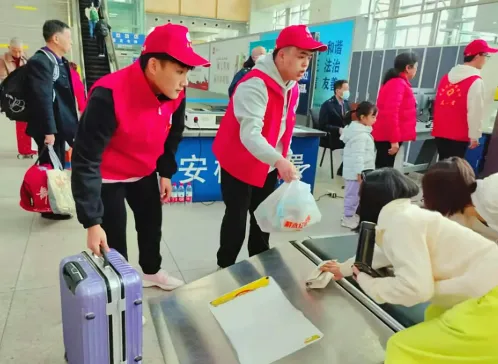
2. Use the "Red Cap" or "Light Travel" Services
If you have multiple bags, don't struggle with the escalators.
-
Red Cap Porters: For about 20–30 RMB, these porters can take your bags from the train platform and walk you directly to the metro entrance, often using staff-only elevators that skip the crowds.
-
Light Travel (轻装行): New for 2026, you can use the 12306 app to book "Station-to-Door" delivery. You drop your bags at a kiosk upon arrival, and they are delivered to your hotel within 5 hours for roughly 50–90 RMB.
3. Carriage Strategy: "The Middle is Best"
High-speed trains are long (up to 16 cars).
-
The Exit Trap: If you are in Car 1 or Car 16, you might have a 400-meter walk just to reach the station exit.
-
The Sweet Spot: Aim for Carriages 5 through 10. These are almost always aligned with the main exit escalators that lead directly down to the metro level.
4. Navigation: Amap (Gaode) vs. Apple Maps
In 2026, English-language navigation has peaked.
-
Apple Maps: If you have an iPhone, use it. It uses Amap’s data but is fully translated. It will tell you exactly which Metro Exit (e.g., "Exit C3") is closest to your hotel.
-
Amap (English Mode): Now available for Android and iOS, Amap offers "Lane-Level Navigation," showing you exactly which side of the hallway to walk on to reach the subway transfer.
5. Etiquette & Flow
-
The "Right Side" Rule: On escalators, stand on the right and walk on the left. During rush hour, this is strictly observed.
-
Drink Inspection: At some metro security checks (if you exit the "sterile zone"), you might be asked to take a sip of your water or place your bottle on a specialized liquid scanner. Don't be alarmed—it's a standard safety procedure.
-
No Food: Eating on the metro is generally forbidden and can result in a fine. Finish your station snacks before you board.
Quick Troubleshooting Table
| Problem | Immediate Solution |
| Phone Died | Look for a "Meituan" or "Jiedian" power bank rental station near the gates. |
| QR Code Error | Go to the "Customer Service" ($服务中心$) window; they can scan your passport to verify your entry. |
| Lost in Station | Look for the "i" Information desk or roaming robots with "English" buttons. |
| Missed Last Train | Follow signs for "Official Taxi" or use "DiDi" inside the Alipay app. |
VI. Frequently Asked Questions (FAQ)
Q1: How long does a typical train to metro transfer take in China?
A: 5-20 minutes, depending on the station's integration.
Q2: Do I need cash for metro tickets?
A: No, apps like Alipay suffice.
Q3: Are there English signs in all stations?
A: Most major ones yes, but apps help in smaller cities.
Q4: Can I transfer with a lot of luggage?
A: Yes, but it requires strategy. Most metro transfer corridors have wide gates for luggage and elevators for heavy bags. If you are carrying multiple large suitcases, highly consider hiring a "Red Cap" (小红帽) porter at the high-speed rail platform or using the 12306 app's luggage delivery service to send bags straight to your hotel.
Q5: What if my train is delayed?
A: Metros run frequently; check apps for alternatives.
Q6: Is it safe for solo travelers?
A: Very, with well-lit stations and CCTV.
Q7: How to get from Beijing Airport to metro after train?
A: Use Airport Express Line linking to metro.
Q8: Differences in northern vs. southern China transfers?
A: Northern (e.g., Beijing) are more integrated; southern (e.g., Guangzhou) handle tropical weather with AC.
Transferring from a train to the metro in China is a testament to the country's infrastructure efficiency. By having your digital payment ready and following the clear signage, you can navigate even the largest stations in under 15 minutes.
Welcome to China—enjoy the ride!