Planning wheelchair accessible travel in China has undergone a radical transformation. By 2026, the combination of the world’s most extensive High-Speed Rail (HSR) network, revamped urban infrastructure, and cutting-edge "Wheelchair Navigation" apps has made the Middle Kingdom more accessible than ever before.
This guide provides everything you need to know about navigating China’s transport systems, using digital tools, and visiting top attractions with dignity and ease.
⚡ Quick Accessibility Summary:
-
Transport: High-Speed Rail (HSR) is highly accessible, offering designated priority spaces on Fuxing trains.
-
Navigation: Apps like Amap (Gaode) now feature a specific "Wheelchair-Friendly" mode to avoid stairs.
-
Attractions: Major sites like the Badaling Great Wall and the Forbidden City have permanent ramps and elevators.
-
Toilets: Modern malls and transport hubs feature gender-neutral, spacious "Third Toilets".
I. Introduction: Is China Wheelchair-Friendly for Travelers in 2026?
China presents a mixed but progressively improving picture for wheelchair travelers in 2026. If you’re planning a journey focused on accessible transport and navigation, you’ll find both encouraging advances and persistent challenges—especially depending on where in the country you travel.
The 2026 Landscape: Three Key Shifts
-
Legislative Teeth: The Law on the Construction of Barrier-Free Environments (fully implemented over the last two years) has moved accessibility from a "nice-to-have" to a legal requirement for new public buildings, transport hubs, and digital services.
-
The Digital Safety Net: Navigation apps like Amap (Gaode) and Baidu Maps have rolled out sophisticated "Wheelchair-Friendly Routes" in over 30 major cities, helping users avoid stairs, steep slopes, and footbridges without elevators.
-
The High-Speed Era: China’s high-speed rail (HSR) network is now the world’s most wheelchair-accessible long-distance transport system, with level-entry boarding and dedicated "Priority Spaces" available on almost all "Fuxing" class trains.
The Reality Check
Despite these leaps, China is a land of contrasts.
-
The "Last Mile" Struggle: While a subway station might be 100% accessible, the 500 meters of sidewalk leading to your hotel might still feature high curbs, "bump" tiles that are uneven, or poorly placed shared bikes blocking the path.
-
Regional Disparity: Tier-1 cities (Beijing, Shanghai, Shenzhen, Guangzhou) feel like a glimpse into the future. However, in smaller "Tier-3" cities or rural mountainous regions (like parts of Zhangjiajie or Yunnan), you will still encounter significant physical barriers where "human power" (assistance from locals) remains the primary solution.
Suggested "Pro-Tip" Box for your Intro:
The 2026 Golden Rule: In China, "Accessibility" is often synonymous with "Modernity." If a building or train line was built after 2018, it is likely excellent. If it dates back to the 20th century, expect to plan for detours or assistance.
II. Accessibility in China: What to Realistically Expect
Traveling China in a wheelchair is a tale of two eras. While the 2026 "Travel Revolution" has digitized and modernized the experience, you will still encounter the physical legacies of a country that developed at breakneck speed.
1. The "Post-2020" Infrastructure Boom
A key rule of thumb for 2026 is the "Build Date" Rule. Any infrastructure completed in the last five years (especially since the 2023 Law on the Construction of Barrier-Free Environments) is world-class.
-
The Good: Brand-new subway lines (like those in Shenzhen or Chengdu) feature wide elevators, seamless platform-to-train transitions, and tactile paving that actually leads somewhere.
-
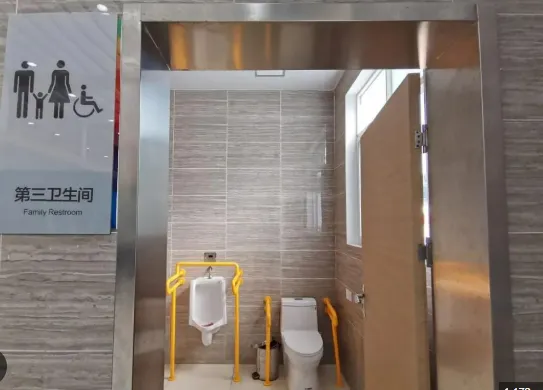
The Great: Modern "Third Toilets" (第三卫生间) are now standard in airports and major shopping malls. These are gender-neutral, spacious, and include emergency pull-cords and grab bars.
2. The "Last Mile" Challenge
The most common frustration for travelers isn't the major sites, but the connection points.
-
Shared Bike Chaos: While sidewalks are wide, they are often crowded with thousands of shared electric bikes. In 2026, many cities have "Strict Parking Zones," but you should still expect to weave through obstacles.
-
Curb Cuts: Even in Beijing, you may find a perfectly ramped sidewalk that ends in a 10cm drop-off at the next intersection.
-
The "Old City" Barrier: Historic districts (like the Hutongs of Beijing or the Longtang of Shanghai) are beautiful but challenging. Narrow doorways and high wooden door thresholds (mĕnkăn) are common.
3. Service Culture: "The Human Ramp"
Perhaps the most important thing to expect is the high level of proactive service.
-
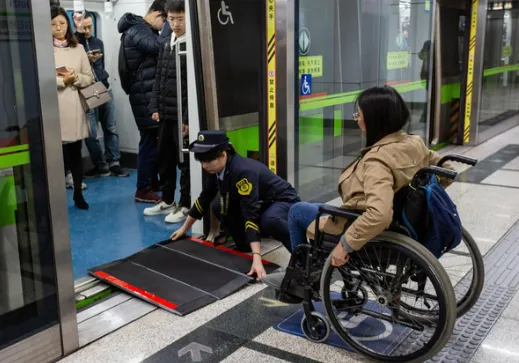
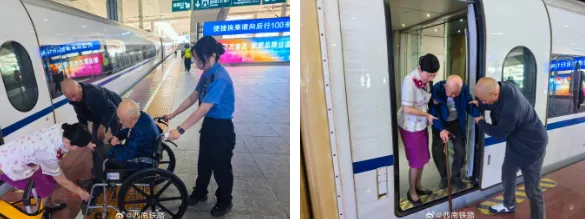
Station Staff: At high-speed rail stations, look for the "12306 Service Desk." Staff are trained to use portable ramps and will often call ahead to your destination station to ensure an escort is waiting for you at the train door.
-
Public Help: If you encounter a few unexpected steps, it is culturally common for locals or security guards to offer a hand. A simple "Néng bāng wŏ yīxià ma?" (Can you help me?) goes a long way.
4. Digital vs. Physical Access
In 2026, China is more "accessible" via a smartphone than a sidewalk.
-
Navigation: Your best friend is Amap (Gaode). Its "Wheelchair-Friendly" mode now filters out overpasses that only have stairs.
-
Everything is Delivered: If a restaurant has a step you can't manage, remember that Meituan or Ele.me can deliver that same world-class food to your accessible hotel lobby in 20 minutes.
Reality Check: Don't expect 100% independence. Even the most seasoned wheelchair travelers in China find that a "successful" day involves a mix of great modern ramps and a little bit of creative problem-solving.
III. Accessible Transportation in China (2026 Updated)
Navigation in China has moved beyond physical ramps to a digital-first ecosystem. If you have the right apps, your mobility increases tenfold.
1. High-Speed Rail (HSR): Your Best Friend
For those taking a China high-speed train in a wheelchair, the HSR network is the most accessible way to cross the country.. In 2026, the new generation of 400km/h "Fuxing" trains offers 4% more cabin space and enhanced accessibility.
-
How to Book: Use the 12306 Official App (which now has a much-improved English interface).
-
Selecting Seats: Look for the "Wheelchair Space" (残疾人卷位) icon when selecting your carriage. On the "Vibrant Express" and newer Fuxing models, these are usually in Car 4 or Car 7.
-
The "Green Channel" Service: You can now request assistance directly in the 12306 app or at the station’s "12306 Service Desk." They will provide:
-
Priority security checks.
-
Elevator access to the platform (avoiding the long walk).
-
A portable bridge-plate to span the gap between the platform and the train.
-
2. Urban Metro: The "MetroMan" & "Amap" Era
By 2026, all Tier-1 and Tier-2 city subways are virtually 100% accessible via elevators, but finding them is the trick.
-
Essential App: MetroMan. Updated for 2026, this app provides detailed station maps showing exactly which exits have elevators (look for the wheelchair icon).
-
The Gap: Most trains are level with the platform, but a 2-5cm gap is common. If you are in a power chair, you’ll likely roll over it; if in a manual chair, a small "wheelie" or reversing in may be safer.
- [How to Use Amap (Gaode Map) in English] is a detail article for first time user.
3. Taxis and Ride-Hailing: The DiDi Strategy
Standard taxis in China are often small sedans with trunks occupied by gas tanks, making wheelchair storage difficult.
-
DiDi (English App): Use the "6-Seater" or "SUV" option to ensure there is enough trunk space for a folding wheelchair.
-
Specialized Accessible Vans: In cities like Beijing, Shanghai, and Guangzhou, you can find specialized "Barrier-Free Taxis" (无障碍出租车). These are equipped with ramps. In 2026, these are best booked 24 hours in advance via your hotel concierge or the DiDi "Special Request" feature.
- [China Ride-Hailing & Taxi Guide: DiDi, Amap & Alipay] helps you when you need to take a taxi in China
4. Flying: 2026 Battery Regulations
If you are traveling with an electric wheelchair, the 2026 CAAC/IATA regulations are strict but clear:
-
Lithium Batteries: Must be under 300Wh. If you have two batteries, each must be under 160Wh.
-
Removal: You must be able to remove the battery and carry it into the cabin. The chair itself will be checked at the gate.
-
Pro Tip: Carry the Technical Specification Sheet (in English and Chinese) of your battery. Security at Chinese airports will check the "Wh" rating and the "UN38.3" safety certification before allowing you to board.
Summary Table: Transport Efficiency
| Mode | Accessibility Level | Key Advice |
| High-Speed Rail | ★★★★★ | Book "Priority Seats" on 12306 app; use the Green Channel. |
| Metro/Subway | ★★★★☆ | Use Amap or MetroMan to find elevator-equipped exits. |
| Ride-Hailing (DiDi) | ★★★☆☆ | Book "SUV/6-Seater" for manual chairs; call ahead for vans. |
| Domestic Flights | ★★★★☆ | Arrive 2 hours early; keep battery specs ready for security. |
IV. Navigating Chinese Cities in a Wheelchair
In 2026, the digital and physical landscapes of Chinese cities are more integrated than ever. However, "roll-ability" still depends heavily on which district you are in and which app you are using.
1. The Digital Navigator (Your Secret Weapon)
The biggest update for 2026 is the expansion of Amap's (Gaode) "Barrier-Free" (无障碍) mode.
-
Navigation: When you set a walking route, look for the wheelchair icon. The app will reroute you to avoid pedestrian overpasses that lack elevators and suggest "level-crossings" or subway underpasses instead.
-
Indoor Maps: Major malls in Shanghai, Beijing, and Shenzhen now have 3D indoor maps. They can guide you directly to the nearest elevator or accessible restroom (Dìsān Wèishēngjiān).
2. Sidewalks and "The Last Mile"
-
Tier-1 Cities (Shanghai, Shenzhen, Beijing): Central Business Districts (CBDs) like Shanghai’s Pudong or Beijing’s Guomao are excellent. Sidewalks are wide, smooth, and feature consistent curb cuts.
-
The "Shared Bike" Hurdle: Even in 2026, sidewalks can be cluttered with shared e-bikes. Tip: Stick to the designated "non-motorized vehicle" lanes (where bikes ride) if the sidewalk becomes too narrow; they are paved smooth and usually separated from heavy traffic by a barrier.
-
Tactile Paving: While designed for the visually impaired, these yellow "bump" tiles can be jarring. In newer districts, they are often recessed or smoother, but in older areas, you may want to navigate around them to save your front casters.
3. Crossing the Street: A New 2026 Standard
In the past, many Chinese intersections used massive pedestrian bridges.
-
The Good News: Urban renewal projects in 2026 have added elevators to almost all major overpasses in Tier-1 cities.
-
The 2026 Update: Many cities have replaced bridges with "at-grade" crossings (street level) and added audible/vibrating signals for safer crossing.
4. Accessible Ride-Hailing (Beijing Special)
As of late 2025/early 2026, Beijing launched "Zhi Ling Chu Xing" (智龄出行), a dedicated mini-program for wheelchair-accessible ride-hailing.
-
What it is: A service specifically for vehicles with ramps/lifts.
-
How to use: It requires booking at least 4 hours in advance. It is currently in trial but is the gold standard for power-chair users who cannot transfer into a standard DiDi.
5. Urban Toilets: Look for the "Third Toilet"
In your guide, tell readers to look for the "Third Toilet" (第三卫生间).
-
These are independent, spacious rooms designed for disabled travelers and families.
-
Where to find them: All 2026-era subway stations, Starbucks, and high-end malls (like IFC or SKP) are guaranteed to have them.
Local Hack: If you are stuck without an elevator, look for a nearby subway entrance. Even if you aren't taking the train, you can use the station's elevators to cross a busy 8-lane highway underground.
V. Finding Wheelchair Accessible Hotels in China: A Truly Accessible Stay
Thanks to the 2023 Law on the Construction of Barrier-Free Environments, almost all hotels built or renovated after 2024 are now legally required to offer a set percentage of accessible rooms. However, "accessible" in a local 3-star hotel can mean something very different than in an international 5-star brand.
1. The "Safe Bet" Strategy: International Brands
For a guaranteed roll-in shower and wide doorways, stick to international chains (Marriott, Hilton, IHG, Hyatt, Accor).
-
Why: These brands generally follow global accessibility standards (ADA-like) rather than just local minimums.
-
Top Picks for 2026: * Shanghai: Shanghai Marriott Marquis City Centre or The Peninsula (known for excellent step-free layouts).
-
Beijing: Holiday Inn Express (modern, budget-friendly, and very standardized).
-
Shenzhen: JW Marriott or Andaz (high-tech, spacious elevators).
-
2. How to Book (The "Hidden Filter" Problem)
Apps like Trip.com (携程) have improved their filters by 2026, but the "Wheelchair Accessible" tag can sometimes just mean the lobby has a ramp, not the room.
-
Pro Tip: After booking on Trip.com, use the "Chat with Hotel" feature. Send this specific phrase:
"请问有带无障碍淋浴间(没有门槛)的房间吗?我使用的是轮椅。" (Do you have a room with a barrier-free shower (no threshold)? I use a wheelchair.)
3. What to Look for in a 2026 "Accessible Room"
In China, these are often called "Wúzhàng'ài Kèfáng" (无障碍客房). A proper one should include:
-
No Thresholds: The entrance and bathroom must be flush with the floor.
-
Grab Bars: Sturdy bars next to the toilet and inside the shower area.
-
Emergency Cords: A pull-cord near the floor in the bathroom (standard in 2026).
-
Lowered Fixtures: Light switches and peepholes at a lower height.
4. The "Skip-Gen" Travel Trend
In 2026, China is seeing a boom in "Skip-Gen" travel (grandparents traveling with grandkids). This is great for you because hotels are adding "Senior-Friendly" features like non-slip mats and shower chairs as standard amenities. Even if a room isn't labeled "Accessible," it might be quite usable.
5. Essential "Reality Check" for Hotels
-
The "One Step" Bathroom: Many older Chinese hotels (pre-2015) have a 10-15cm step up into the bathroom to accommodate plumbing. Avoid these.
-
Carpet vs. Hardwood: Newer hotels are moving toward laminate or tile, which is much easier for manual wheelchair users than the thick, plush carpets found in older luxury hotels.
Comparison: Luxury vs. Local Boutique (2026)
| Feature | International 5-Star | Local Boutique / 3-Star |
| Shower Type | Roll-in / Walk-in | Often a bathtub (request a chair) |
| Door Width | 85cm+ (Standard) | May be narrow (70-75cm) |
| Staff Training | Familiar with disability needs | Very willing to help, but may need guidance |
| Elevators | Multiple, voice-announced | May be small; check if they reach all floors |
VI. Tourist Attractions & Sightseeing
In 2026, sightseeing in China is about balancing high-tech convenience with the reality of ancient architecture. Many "bucket-list" sites have undergone massive accessibility upgrades for the 15th Five-Year Plan.
1. The Great Wall: Badaling vs. Mutianyu
The age-old debate has a clear winner for wheelchair users in 2026.
-
Winner: Badaling Great Wall. It is the only section with a specially designed elevator system and a flat "ramp" path that allows you to reach the top of the wall without a single step.
-
Pro Tip: You must book the elevator/barrier-free access in advance. Use the "Badaling" official WeChat mini-program or have your hotel concierge call to confirm the lift is operational on your visit day.
-
-
Alternative: Mutianyu. While it offers a cable car to the top, once you are on the wall, it is much more rugged with uneven stones and steep grades. It's only recommended if you have a strong companion or a powerful all-terrain electric chair.

2. The Forbidden City (Beijing)
Navigating a 600-year-old palace sounds daunting, but there is a "Secret Path."
-
The Route: Stick to the Eastern side of the central axis. While the main central line has massive marble stairs (the "Imperial Way"), the side paths have been fitted with permanent and portable ramps.
-
Navigation: Look for the "Wheelchair Accessible Map" at the Meridian Gate (main entrance).
-
2026 Update: Most of the high wooden thresholds (mĕnkǎn) that used to be deal-breakers have been fitted with small, removable rubber ramps.
3. The Bund & Lujiazui (Shanghai)
Shanghai is China's most "rollable" city.
-
The Bund: The entire waterfront promenade is 100% accessible via elevators located at major intersections (like Nanjing Road East). The view is unobstructed and the pavement is smooth.
-
Shanghai Tower: In 2026, this remains the gold standard. From the underground metro connection to the 118th-floor observation deck, the journey is entirely step-free with spacious, high-speed elevators.
4. The Terracotta Warriors (Xi'an)
-
Accessibility: Excellent. Pit 1, Pit 2, and the Museum are all equipped with ramps and elevators.
-
Pro Tip: The walk from the parking lot to the entrance can be long (nearly 1km). Use the electric shuttle buses; in 2026, these have been updated with fold-down ramps for wheelchairs.
VII. Apps & Technology for Wheelchair Travel
Smartphones are essential companions for wheelchair travelers in China. With the right apps and tools, you can plan routes, check accessibility, hail transport, and stay safer and more informed — even where infrastructure is inconsistent.
This section highlights the most useful apps, tech tools, and navigation strategies that make a real difference on the ground.
1. Navigation: Amap (Gaode) vs. Baidu Maps
While Apple Maps is okay for basic orientation, it lacks the specialized "Barrier-Free" data found in local apps.
-
Amap (高德地图) "Wheelchair Mode": This is the gold standard for 2026.
-
How to activate: Set your destination, choose "Walking" (步行), and look for the wheelchair icon or the "Barrier-Free" (无障碍) filter.
-
What it does: It automatically reroutes you to avoid stairs, steep footbridges, and subway exits that only have escalators. It also highlights "Accessible Restrooms" along your path.
-
-
Baidu Maps (百度地图): Similar to Amap, but better for Indoor Navigation. It can lead you floor-by-floor to the specific elevator bank in massive malls like Beijing's SKP or Shanghai's IFC.
2. Transport: The "All-in-One" Super Apps
You don't need to download 20 apps. Almost everything lives inside Alipay or WeChat.
-
12306 (Train Booking): As of 2026, the official railway app has a dedicated "Special Needs" (重点旅客预约) button. You can request a "Green Channel" escort 24 hours before your train departs.
-
DiDi (Ride-Hailing): In the DiDi mini-program, use the "Six-Seater" or "SUV" option. In Beijing, look for the "Zhi Ling Chu Xing" (智龄出行) mini-program specifically for vehicles with wheelchair ramps (requires 4-hour advance booking).
- More transport apps are here in [The Absolute Must-Have Apps for China Transportation]
3. Translation: Your "Digital Voice"
-
WeChat Scan: Use the "Scan" feature on any Chinese sign or menu; it provides an instant augmented-reality (AR) translation.
-
Voice-to-Voice: Use iFlytek or Baidu Translate. In 2026, these are fast enough to hold a real-time conversation with a bus driver or hotel clerk about your specific mobility needs.
- [Best Translation Apps for China] help you when you can't speak Chinese.
4. Essential 2026 Technology Tips
-
Battery Specs: If using an electric wheelchair, keep a photo of your battery’s Technical Data Sheet (showing Wh and UN38.3 certification) in a favorited album on your phone. You will need to show this at every airport security check and some high-speed rail security points.
-
Power Banks: 2026 China is fully "Rentable." If your phone or electric wheelchair control unit (via USB) is low, look for Meituan or Energy Monster power bank kiosks—found in every accessible restroom and restaurant.
VIII. Practical Tips for 2026
-
Power Adapters: China uses 220V. Ensure your electric wheelchair charger is compatible or bring a heavy-duty transformer.
-
The "Blue Book" (Disability Certificate): While foreign disability IDs aren't always officially recognized for discounts, showing one (or a photo of it) often grants you "Green Channel" (priority) access at tourist sites.
-
Sidewalk Reality: While main roads are great, smaller alleys (Hutongs or Longtangs) may have high door sills or uneven pavement. Always have your Amap "Wheelchair Mode" active.
-
Air Travel: As of late 2025, new CAAC regulations allow travelers to keep their personal wheelchairs until the boarding gate at most major hubs like Daxing (PKX) and Pudong (PVG).
Essential Chinese Phrases for Travelers
While many younger people speak English, these phrases (written in Chinese characters) will be your "Golden Ticket" when dealing with security or station staff.
| English | Chinese (Simplified) | Pinyin |
| Where is the elevator? | 电梯在哪里? | Diàntī zài nǎlǐ? |
| Is there a ramp? | 有坡道吗? | Yǒu pōdào ma? |
| I need help, please. | 请帮帮我。 | Qǐng bāngbang wǒ. |
| Disabled toilet | 无障碍卫生间 | Wúzhàng'ài wèishēngjiān |
| Barrier-free entrance | 无障碍通道 | Wúzhàng'ài tōngdào |
| Can you open the lift? | 请打开电梯。 | Qǐng dǎkāi diàntī. |
IX. Sample Wheelchair-Friendly Itineraries (2026)
In 2026, the "Golden Triangle" (Beijing, Xi'an, and Shanghai) remains the most accessible route for first-time visitors due to the maturity of their high-speed rail links and barrier-free infrastructure.
Option 1: The "Imperial Highlights" (5 Days)
Focus: History, Modernity, and Ease of Access.
-
Day 1: Arrive Beijing. Use a pre-booked accessible van (via Zhi Ling Chu Xing) to a hotel in Wangfujing. Explore the wide, pedestrian-only Wangfujing Street.
-
Day 2: The Palace & The Square. Visit Tiananmen Square (accessible security lanes) and the Forbidden City. Follow the "Eastern Axis" route to avoid stairs.
-
Day 3: The Great Wall. Take a private car to Badaling. Use the dedicated elevator system to reach the ramped section of the wall.
-
Day 4: To Shanghai via HSR. Board a "Fuxing" train from Beijing South. Arrive at Shanghai Hongqiao and take the Metro (all-elevator access) to The Bund.
-
Day 5: Sky-High Shanghai. Roll through the Lujiazui Financial District. Take the accessible elevator to the 118th floor of the Shanghai Tower, then end with a barrier-free Huangpu River Cruise.
Option 2: The "Pandas & Warriors" Extension (8 Days)
Focus: Wildlife, History, and Regional Diversity.
-
Days 1–3: Same as above (Beijing).
-
Day 4: High-Speed Rail to Xi'an. (approx. 4.5 hours). Stay near the South Gate of the City Wall for the best sidewalk accessibility.
-
Day 5: The Terracotta Army. Use an accessible shuttle from the parking lot. Explore Pits 1, 2, and 3 via the ramped viewing galleries.
-
Day 6: Xi'an to Chengdu. (approx. 3.5 hours). Chengdu's sidewalks are some of the flattest in China.
-
Day 7: Giant Panda Base. Visit the Chengdu Research Base of Giant Panda Breeding. In 2026, the new expansion is 100% accessible with electric carts equipped with wheelchair ramps.
-
Day 8: Departure. Fly out of Chengdu Tianfu International (TFU)—one of the world's most modern, barrier-free airports.
X. Frequently Asked Questions (FAQ)
Q1: Is China fully wheelchair-accessible in 2026?
A: No. Major cities like Beijing, Shanghai, Guangzhou, and Shenzhen offer significant accessibility improvements, but older neighborhoods, historic sites, and smaller cities may still have uneven sidewalks, stairs, and limited ramps. Planning and realistic expectations are key.
Q2: Can I bring my electric wheelchair on a domestic flight in China?
A: Yes, but with strict CAAC/IATA regulations. Your lithium battery must be under 300Wh (or two batteries under 160Wh each). You must carry the battery into the cabin, while the wheelchair itself is checked at the gate. Always bring the battery's UN38.3 English technical sheet for security checks.
Q3: Is the Great Wall actually doable without a companion?
A: At Badaling, yes. It is the most accessible section with a dedicated elevator and ramp system. However, for other sections like Mutianyu or Jinshanling, a companion or a sturdy power chair is highly recommended due to the steep inclines and uneven stone surfaces.
Q4: What should I do if my wheelchair breaks in China?
A: China is the global hub for wheelchair manufacturing. In major cities, you can use Meituan to find local medical supply stores or search for "wheelchair repair" (轮椅维修) on Amap. It’s wise to carry a basic toolkit (Allen wrenches and a pump) for minor adjustments.
Q5: Do I need a Chinese phone number for accessibility apps?
A: While most apps work with international numbers, having a local eSIM makes everything smoother. Many public "Barrier-Free" services or lift-request mini-programs are optimized for users with a +86 number.
China’s commitment to an "Accessible Environment" (无障碍环境建设法) has reached its peak in 2026. Whether you are taking the 350km/h bullet train or navigating the neon streets of Chongqing, the infrastructure is ready for you.
Pro Tip: Always carry a portable power bank for your phone—it is your map, your translator, and your key to an accessible China.