Planning a cross-border trip? Compare the best ways to travel from Hong Kong to Mainland China. Discover High-Speed Rail, SkyPier ferry, and bus options for a seamless journey.
There are multiple ways to travel from Hong Kong to Mainland China, but the best option depends on more than just distance. Border procedures, departure points, luggage policies, and service frequency all play a role in how smooth the journey will be. This article compares the main cross-border transport options from Hong Kong, helping you understand how each one works and when it makes sense to choose it.
⚡ Quick Summary:
-
Fastest Overall: High-Speed Rail (HSR) from West Kowloon Station.
-
Best for Airport Transit: SkyPier Ferry (Bypass Hong Kong immigration entirely).
-
Cheapest Option: MTR East Rail Line (Under HKD 100).
-
Most Convenient for Luggage: Private Cross-Boundary Transfers.
1. Introduction
Who this guide is for
This guide is designed for travelers navigating the transit corridor between the Hong Kong Special Administrative Region (HSR) and Mainland China. It serves:
-
First-time visitors unfamiliar with the regional transport landscape.
-
Transit passengers arriving at Hong Kong International Airport (HKG) looking for seamless onward connections.
-
Business and leisure travelers heading to the Greater Bay Area (GBA) or major Chinese hubs.
Why choosing the right transport matters
The connection between Hong Kong and the Mainland is one of the world's busiest. Your choice of transport significantly impacts:
-
Total Travel Time: Ranging from 15 minutes to over 3 hours.
-
Border Procedures: Some options offer "co-location" (clearing both borders in one building), while others require disembarking with luggage.
-
Luggage Handling: Rail and bus have stricter limits than ferries or private transfers.
Notes on pricing and schedules
All prices, frequencies, and journey times mentioned in this guide are indicative. They are subject to seasonal adjustments, carrier policy changes, and peak-period demand.
2. Overview of Traveling from Hong Kong to Mainland China
Travelers can choose from five primary modes of transport:
-
High-Speed Rail (HSR): The fastest link to major cities like Shenzhen, Guangzhou, and beyond.
-
Ferry: Direct sea routes from HKG Airport or downtown to coastal GBA cities.
-
Cross-Boundary Bus: Extensive network reaching suburban districts and hotels.
-
MTR Cross-Border Routes: Local metro lines connecting to the Shenzhen border.
-
Taxi & Private Transfers: Door-to-door convenience for groups or business travelers.
Quick Comparison Table
|
Criteria |
High-Speed Rail |
Ferry |
Cross-Boundary Bus |
MTR (East Rail) |
Private Transfer |
|---|---|---|---|---|---|
|
Main Destinations |
SZ, GZ, Beijing, Shanghai |
SZ, GZ, Zhongshan, Zhuhai |
GBA Cities, Hotels |
Shenzhen Border |
Door-to-door |
|
Travel Time |
15–50 mins (to GZ/SZ) |
30–90 mins |
1.5–3 hours |
45–60 mins |
1–2.5 hours |
|
Price Range |
Moderate - High |
Moderate |
Budget - Moderate |
Budget |
High |
|
Border Complexity |
Low (One-stop) |
Moderate (Terminal) |
High (Disembark twice) |
High (Walk across) |
Very Low (In-car) |
|
Luggage Friendliness |
Moderate |
High |
Moderate |
Low |
Very High |
|
Best For |
Speed & comfort |
Transit from Airport |
Reach & price |
Budget travelers |
Families/Business |
3. Ferry from Hong Kong International Airport to Mainland China
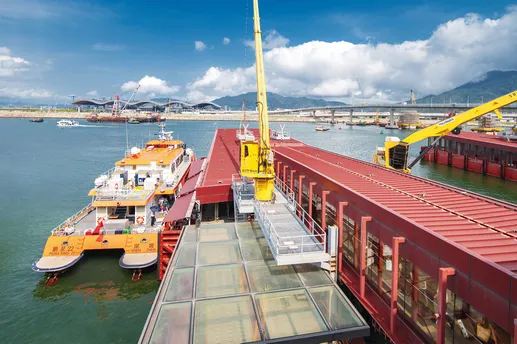
SkyPier Terminal at Hong Kong International Airport (HKIA) provides speedy ferry services for transfer passengers to mainland China.
Where Can You Travel by Ferry from Hong Kong International Airport?
The SkyPier Terminal at Hong Kong International Airport (HKG) provides a unique "sea-to-air" and "air-to-sea" link, allowing transit passengers to bypass Hong Kong immigration and travel directly into the Pearl River Delta.
-
Major Mainland Destinations: Dongguan Humen, Guangzhou Nansha, Guangzhou Pazhou, Shenzhen Fuyong, Shenzhen Shekou and Zhongshan. (The ferry service to Zhuhai Jiuzhou is temporarily unavailable).
-
Direct Air-to-Sea Connection: This service is exclusive to passengers arriving by air at HKIA who wish to proceed directly to Mainland China ports.
Riding Guide
Passengers looking to take a ferry to the Chinese Mainland should proceed to the ferry ticketing counter at Transfer Area E2. DO NOT go through immigration and reclaim your baggage. Passengers who have gone through immigration procedures CANNOT return to the ferry ticketing counter and use the ferry service.
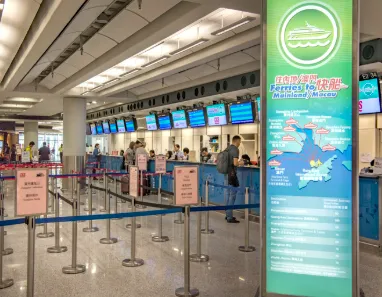
To use the service, passengers must:
- Possess the following items:
- Same day arrival flight air ticket / e-ticket / boarding pass stub
- A valid ferry ticket
- A valid passport and, if applicable, a visa for the intended destination (Chinese Mainland / Macao) - Transfer to Chinese Mainland within the same day of arrival
- Arrive at the Ferries to Chinese Mainland located at Transfer Area E2 at least 60 minutes before the scheduled ferry departure time for ticketing and transfer procedures. For passengers without checked baggage, 30 minutes would be sufficient;
- For passengers with checked baggage, please present the airline baggage tag receipt for customs clearance and baggage transfer procedures.
- Remain in the airport restricted area during the entire transfer process.
Ferry Ticket Prices from HKG Airport
-
Typical Price Range: Fares from the SkyPier range from HKD 280 to HKD 400 per adult, depending on the destination port.
-
Seat Classes: Most airport ferries offer Economy and First Class/Super Class. First class features priority luggage retrieval and enhanced seating.
How to Buy Ferry Tickets
-
Arrivals at HKIA: Follow signs for "Mainland/Macao Ferries" in the Arrival Hall. Do NOT pass through Hong Kong immigration or pick up your checked bags.
-
Booking: Tickets can be purchased at the "Ferries to Mainland" counter at the Transfer Area E2. You must present your airline baggage tags to the counter staff so they can redirect your luggage to the ferry.
-
Payment Methods: Credit cards, WeChat Pay, and Alipay are standard.
Ferry Schedule and Travel Time
CKS (Services to / from Shenzhen Shekou, Shenzhen Fuyong, Dongguan Humen, Zhongshan, Zhuhai, Guangzhou Nansha and Guangzhou Pazhou)
-
Departures: Shenzhen Shekou runs frequently (approx. hourly), while routes like Pazhou or Zhongshan may have limited daily sailings.
-
Average Duration: * To Shenzhen Shekou: 30 minutes.
-
To Guangzhou Nansha/Pazhou: 70–90 minutes.
-
To Zhuhai: 70 minutes.
-
Immigration and Border Control for Airport Ferry Passengers
-
Bypassing HK Immigration: Passengers do not clear Hong Kong immigration. You are officially in "transit" until you reach your Mainland destination port.
-
Mainland Clearance: You will clear Chinese Immigration and Customs at the arrival port (e.g., Shekou or Zhuhai).
-
Requirement: You must have a valid ticket and arrive at the ferry counter at least 60 minutes before departure (to allow for baggage transfer).
HKIA SkyPier Boarding Location
-
Restricted Area Only: SkyPier is located within the airport’s restricted area. It is NOT accessible to the general public from the landside.
-
Access: Reachable via the Automated People Mover (APM) train from Terminal 1.
Luggage Allowance on Airport Ferries
-
Automatic Transfer: Your airline-checked bags will be transferred directly from the aircraft to the ferry by terminal staff.
-
Weight Limits: Ferry hand baggage must not exceed 9" x 14" x 22". Generally aligned with airline standards (20kg–30kg per piece). Fees apply for additional pieces or overweight bags.
Pros and Cons of Airport Ferry
-
Pros: Most convenient for transit; skip HK customs/immigration; no need to carry heavy bags through borders; eligible for HKIA Air Passenger Departure Tax refund (HKD 120).
-
Cons: Expensive; restricted to air passengers only; fixed schedules; missed ferry means waiting for the next available sailing.
Is the Airport Ferry the Best Option for You?
-
Typical Use Cases: International travelers arriving at HKG who want a seamless, luggage-free transition to the Mainland.
-
Common Mistakes: Passing through HK immigration and exiting to the public Arrival Hall. Once you clear HK immigration, you cannot return to SkyPier and must take a bus or train instead.
4. Bus Services from HKG Airport to Mainland China
There are two distinct types of bus services operating from the airport. Choosing the correct one depends on whether you intend to enter Hong Kong or transit directly.
Type 1: SkyPier Terminal Transfer Coach (Air-to-Land Transit)
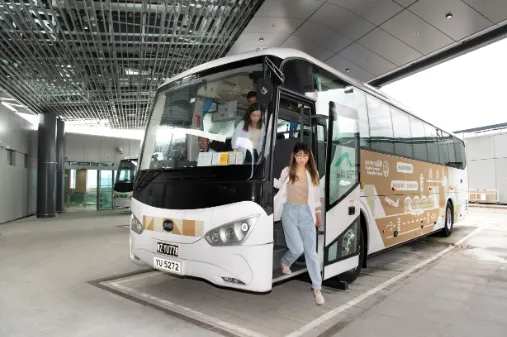
This is a restricted "bonded" bus service similar to the ferry. It is designed for passengers who wish to transit directly to the Mainland without clearing Hong Kong immigration.
-
Destinations: Currently primarily serves Hong Kong-Zhuhai-Macao Bridge (HZMB) Zhuhai Port.
-
Key Feature: You do not clear Hong Kong immigration. Your checked luggage is transferred automatically from the plane to the coach.
-
Ticketing: Purchase at the "Mainland/Macao Ferries" counter at Transfer Area E2 (before immigration).
- Process: Passengers who need to take a SkyPier Terminal Transfer Coach to Chinese Mainland should proceed to the SkyPier Terminal Transfer Coach Ticketing Counter at Transfer Area E2, DO NOT go through immigration and reclaim your baggage. Passengers who have already gone through immigration procedures CANNOT return to the ticketing counter and use the transfer coach service.
-
Immigration Arrangement (Co-location): This service features a "Co-location" arrangement (or one-stop clearance) for transit passengers.
-
Passengers clear customs and immigration at the SkyPier Terminal (Terminal 1 Midfield) before boarding the coach.
-
You do not enter the Hong Kong SAR territory; you are transferred directly from the airport restricted area to the bridge.
-
To use the service, passengers must:
- Possess the following items:- Same day arrival flight air ticket/ e-ticket/ boarding pass stub- A valid transfer coach ticket- A valid passport and, if applicable, a visa for the intended destination (Chinese Mainland/Macao)
- Transfer to Chinese Mainlandwithin the same day of arrival
- Arrive at the SkyPier Terminal Transfer Coach Ticketing Counter located at Transfer Area E2 at least 60 minutes before the scheduled transfer coach departure time for ticketing and transfer prcedures. For passengers without checked baggage, 30 minutes would be sufficient;
- For passengers with checked baggage, please present the airline baggage tag receipt for customs clearance and baggage transfer procedures.
- Remain in the airport restricted area during the entire transfer process.
Note: for transfer passengers only; it is not available to those originating from Hong Kong.
Type 2: Chinese Mainland / Macao Coaches (Public Cross-Boundary Bus)
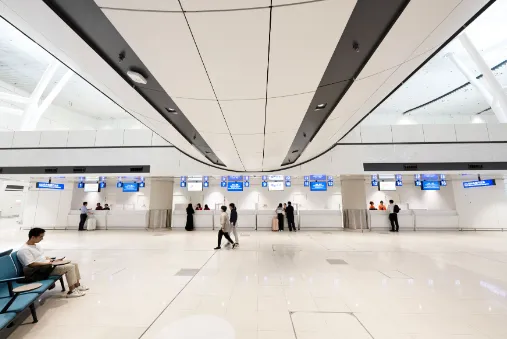
These are standard cross-boundary coaches accessible from the public area of the airport. Destinations: Extensive network covering Shenzhen, Guangzhou, Dongguan, Huizhou, Foshan, and Zhongshan.
-
Process: You must clear Hong Kong immigration, collect your luggage, and then head to the bus center. You will clear Mainland customs at the land border (e.g., Shenzhen Bay Port).
- Boarding point: 📍Bays 20-26, Mainland/ Macao Transport and Travel Services Centre, Level 3 (L3), Terminal 2.
-
Ticketing: Purchase at the Mainland/Macao Transport Centre in the Arrival Hall (after clearing HK immigration). 📍Counters 01-16, Mainland/ Macao Transport and Travel Services Centre, Level 3 (L3), Terminal 2.
-
Immigration Arrangement (Two-Stop Clearance):
-
Passengers must first clear Hong Kong Immigration in the airport arrival hall to enter the public area.
-
After boarding the bus, you will travel to a land border (e.g., Shenzhen Bay Port or HZMB Zhuhai Port).
-
You must disembark at the border checkpoint with your luggage to clear Mainland China Customs and Immigration.
-
Bus Ticket Prices from HKG Airport
-
Transfer Coach (SkyPier): Approx. HKD 200 – HKD 300.
-
Public Coaches: HKD 150 to HKD 280, depending on the city and destination.
Schedule and Travel Time
Service providers:
CTG BUS
Eternal East Tours Company Limited
S.T. Travel
KCTIL Travel
-
Frequency: Public coaches depart every 30 minutes for major routes. Transfer coaches have fixed schedules synchronized with flights.
-
Travel Time:
- To Zhuhai via HZMB: 45 minutes.
-
To Shenzhen: 1–1.5 hours.
-
To Guangzhou: 3 hours.
Boarding Locations at HKIA
-
Transfer Coach: Access via the APM train to SkyPier Terminal (Restricted Area).
-
Public Coaches: Bays 20-26, Mainland/ Macao Transport and Travel Services Centre, Level 3 (L3), Terminal 2.
Luggage Allowance and Handling
-
Transfer Coach: Hands-free; staff move your airline bags.
-
Public Coaches: You must manage your own luggage during the transfer from the baggage carousels to the bus and through the land border checkpoints.
Pros and Cons Comparison
|
Feature |
SkyPier Transfer Coach |
Public Mainland Coaches |
|---|---|---|
|
HK Immigration |
Skip (No entry to HK) |
Must Clear (Entry to HK) |
|
Baggage |
Automated Transfer |
Self-managed |
|
Coverage |
Limited (mainly Zhuhai) |
Very Wide (GBA Cities/Hotels) |
|
Tax Refund |
Eligible for HKD 120 |
Not Eligible |
Is the Bus the Best Option for You?
-
Choose Transfer Coach if: You are heading to Zhuhai and want to avoid the hassle of clearing Hong Kong immigration and handling bags.
-
Choose Public Coach if: Your destination is a specific hotel in Shenzhen or Guangzhou that the ferry or HSR doesn't reach directly.
Note: Please make sure you have a valid travel document or visa for Chinese Mainland/ Macao before boarding a coach.
5. High-Speed Rail (HSR) via HKG Airport Transfer
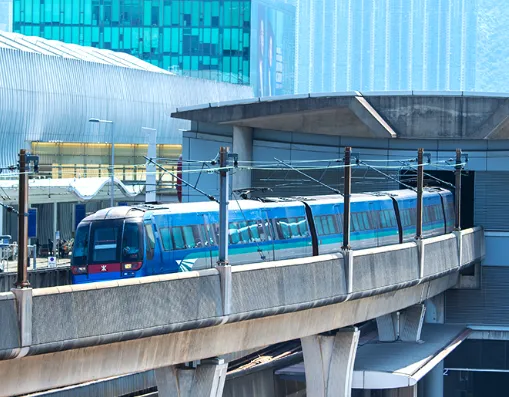
While Hong Kong International Airport (HKIA) does not have a high-speed rail station on-site, it is seamlessly connected to the Hong Kong West Kowloon Station via the Airport Express.
-
The Connection: Take the Airport Express train to Kowloon Station (approx. 24 minutes), then follow the signposted indoor walkway to West Kowloon Station (approx. 8–10 minutes walk).
-
Mainland Destinations: From West Kowloon, you can reach over 70 Mainland cities directly, including Shenzhen, Guangzhou, Xiamen, Shanghai, and Beijing.
- HK West Kowloon Station Guide: HSR, Customs & Visas covering 12306 tickets, Co-location immigration, and boarding times.
Ticket Prices and Combined Fares
-
Airport Express: HKD$115 adult, HKD$57.50 child (HKD$105 adult, HKD$52.50 via Octopus) (to Kowloon Station).
-
HSR Fares: Shenzhen (~HKD 80), Guangzhou (~HKD 230), Beijing (~HKD 1,100+).
-
Ticketing: You can buy HSR tickets online (12306 app or Trip.com) or at the West Kowloon Station counters. It is highly recommended to book in advance as popular trains sell out.
Schedule and Connection Time
-
Airport Express Frequency: Every 10–15 minutes.
-
HSR Frequency: Trains to Shenzhen/Guangzhou depart every 15–30 minutes.
-
Recommended Buffer: Allow at least 2 hours between your flight landing and your HSR departure to account for immigration, baggage claim, and the transfer train.
Immigration Arrangement (Co-location)
-
One-Stop Clearance: Unlike the airport bus, you clear both Hong Kong exit and Mainland entry immigration inside the West Kowloon Station.
-
Process: Once you enter the station and pass the ticket gates, you will walk through the HK immigration hall and then immediately into the Mainland immigration hall.
Luggage Handling for Airport Transits
-
Manual Transfer: You must carry your luggage from the airport arrival hall onto the Airport Express and then through the walk to the HSR station.
-
HSR Limits: Stricter than airlines. Maximum 20kg per adult, and the sum of dimensions should not exceed 130cm. There are no "checked bags" on the train; you must keep them in the overhead or end-of-car racks.
Pros and Cons for Airport Travelers
-
Pros: Fastest land link to Guangzhou/Shenzhen; immune to road traffic; high-speed comfort; reaches inland Chinese cities directly.
-
Cons: Requires a transfer via Airport Express; physically demanding with heavy luggage; requires clearing HK immigration at the airport first.
Is the HSR the Best Option for You?
-
Ideal for: Business travelers heading to downtown Guangzhou/Shenzhen, or those traveling beyond the Greater Bay Area to cities like Shanghai or Beijing.
-
Common Mistakes: Booking a train too close to your flight arrival time. Remember that HSR ticket gates close 5 minutes before departure, and immigration takes time.
6. MTR Cross-Border Connections from HKG Airport
The MTR East Rail Line serves the Lo Wu and Lok Ma Chau border crossings into Shenzhen. To reach these from the airport, passengers must first enter Hong Kong.
-
Primary Route (Bus + MTR):
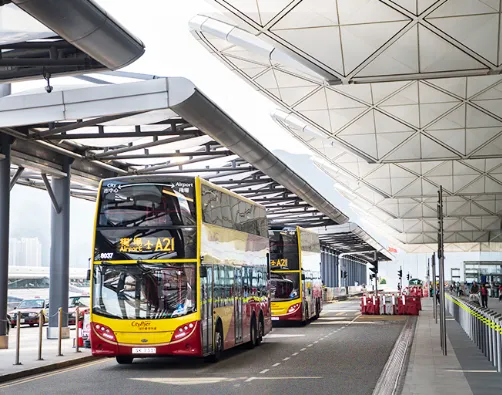 Image from HongKongAirport, Copyright by original authorTake the A21 or E21 Bus to Tai Wai or Sha Tin Station, then transfer to the East Rail Line heading north to Lo Wu or Lok Ma Chau.
 -
Fastest Route (Rail Transfer): Take the Airport Express to Tsing Yi, transfer to the Tung Chung Line to Nam Cheong, then the Tuen Ma Line to Hung Hom/Tai Wai to catch the East Rail Line.
MTR Cross-Border Pricing (from Airport Area)
-
Total Estimated Cost: Approx. HKD 60 to HKD 100 (Bus/Airport Express + MTR fare).
-
Comparison: This is the most budget-friendly way to reach the Shenzhen border from the airport compared to taxis or private cars.
How to Pay for Travel
-
Octopus Card: The standard and most efficient way to pay for all buses and MTR segments.
-
QR Code: Available on most MTR gates and major airport bus lines (AlipayHK, WeChat Pay).
Schedule and Journey Time
-
Frequency: East Rail Line trains depart every 3–8 minutes.
-
Total Travel Time: Approx. 1.5 to 2 hours from HKG Airport to the Shenzhen border, including transfers and wait times.
Immigration and Border Control
-
Two-Stop Clearance:
-
At Airport: Clear Hong Kong Immigration upon arrival to exit the restricted area.
-
At Border: Clear Hong Kong Exit and Mainland Entry immigration halls at Lo Wu or Lok Ma Chau stations.
-
-
Note: Unlike the HSR, there is no "co-location" here. You must walk between the two immigration checkpoints.
Luggage Considerations for Airport Travelers
-
Difficulty: High. Using the local MTR and buses with multiple large suitcases is physically taxing. MTR has strict size limits, and trains can be extremely crowded.
-
Advice: Only choose this if you are traveling with a single backpack or a small carry-on.
Pros and Cons of MTR from the Airport
-
Pros: Very low cost; extremely flexible (no pre-booking needed); frequent service.
-
Cons: Longest travel time; multiple transfers required; difficult with heavy luggage; involves clearing HK immigration at the airport.
Is the MTR the Best Option for You?
-
Ideal Traveler Profile: Budget-conscious solo travelers or backpackers who are not in a hurry and want to enter Shenzhen directly into the local metro network.
-
Common Mistakes: Attempting this route during rush hours (7:30-9:30 AM or 5:30-7:30 PM) with large luggage.
Read this guide [How to Get from Hong Kong to Macau] , a Hong Kong to Macau day trip is so easy and fun.
7. Taxi and Private Transfers from HKG Airport
Types of Services Available at the Airport
For travelers arriving at HKG Airport seeking door-to-door convenience to the Mainland, there are two primary vehicle-based options:
-
Cross-Boundary Private Cars (Dual-Plate MPVs): These are premium 7-seater vehicles (often Toyota Alphards) with both Hong Kong and Guangdong license plates. They provide a direct service from the airport arrival hall to your final destination in the Mainland.
-
Hong Kong Urban/Rural Taxis to the Border: You can take a standard Hong Kong taxi (Red or Green) from the airport taxi stand to a land border crossing (e.g., Shenzhen Bay Port or HZMB), where you then disembark to clear immigration and switch to a Mainland taxi.
Pricing & Booking
-
Typical Private Transfer Cost:
-
HKIA to Shenzhen: HKD 900 – HKD 1,400 per car.
-
HKIA to Guangzhou/Dongguan: HKD 2,800 – HKD 3,800 per car.
-
Tip: Booking via official counters in the Arrival Hall or pre-booking online is essential for these rates.
-
-
Taxi to Border Cost: * HKIA to Shenzhen Bay Port: Approx. HKD 250 – HKD 350 (including tolls).
-
Booking Methods: Visit the Mainland/Macao Transport Centre in the Arrival Hall (Terminal 1) to hire a licensed private car on the spot.
Border Procedures: The "In-Car" Advantage
-
The Shenzhen Bay / HZMB Experience: If you book a dual-plate private car, you can enjoy in-car immigration clearance at the Shenzhen Bay Port or the Hong Kong-Zhuhai-Macao Bridge.
-
How it Works: You stay in the vehicle while the driver presents your travel documents to the officers at the drive-through booths. This is the only transport mode where you do not need to walk through a crowded immigration hall.
-
Standard Taxi Note: If you take a standard HK taxi, you will be dropped off at the "Departure" curb and must walk through the checkpoint with your luggage.
Pros & Cons for Airport Travelers
-
Pros: Most comfortable option after a long flight; zero luggage lifting (for private cars); 24/7 availability; perfect for groups/families.
-
Cons: Most expensive option; susceptible to road traffic on the Guangshen Expressway; private cars require pre-arrangement or queueing at the airport counter.
Who Should Choose This Option?
-
Business Travelers: Those needing to reach a specific factory or office in the GBA quickly and privately.
-
Families with Kids/Seniors: The convenience of avoiding multiple transfers and long walks is worth the premium.
-
Night Arrivals: If your flight lands after midnight when ferries and trains have stopped, a private car or taxi to the 24-hour Huanggang border is your best choice.
8. Which Is the Best Way to Travel from Hong Kong to Mainland China?
Choosing the right mode of transport depends on your specific priorities. Use the decision guide below to find your ideal match.
Decision Guide by Priority
|
Priority |
Recommended Option |
Why? |
|---|---|---|
|
Budget |
MTR (East Rail Line) |
Lowest cost (under HKD 60); frequent and flexible. |
|
Travel Time |
High-Speed Rail (HSR) |
Fastest way to city centers; 14-min to Shenzhen, 45-min to Guangzhou. |
|
Luggage (Heavy/Many) |
Ferry or Private Transfer |
Ferry offers high weight limits; Private Transfer avoids all lifting. |
|
Destination City |
Cross-Boundary Bus |
Reaches hotels and industrial districts that trains/ferries miss. |
|
Experience Level |
High-Speed Rail (HSR) |
Modern facilities, English signage, and easy "one-stop" immigration. |
Quick Recommendations
-
🏆 Best for First-Time Visitors: High-Speed Rail (HSR). The co-location immigration and modern station make it the least confusing option.
-
🧳 Best for Heavy Luggage: Private Transfer. Direct door-to-door service means you never have to carry your bags through a station.
-
⚡ Fastest Option Overall: High-Speed Rail (HSR). Bypasses all road traffic and local metro stops.
-
✈️ Best for Airport Transit: Ferry (SkyPier). Clear immigration only once and potentially claim a tax refund.
-
🌙 Best for Late-Night Travel: Cross-Boundary Bus (via Huanggang). The only 24-hour land crossing available.
Related guide [Shenzhen to Hong Kong Border Crossing: Ports & Visas] is a must-read for first-time travelers between Shenzhen (Mainland China) and Hong Kong.
9. FAQ
Q: Where do I clear immigration — Hong Kong or Mainland China?
A: You must clear both. On the HSR and Ferry, this happens in one location or at the terminal. On buses and MTR, you clear them at two separate halls at the border.
Q: Can I use Alipay, WeChat Pay, or credit cards?
A: In Hong Kong, all are accepted for transport. In the Mainland, Alipay and WeChat Pay are essential, though international credit cards can now be linked to these apps.
Q: Are there late-night options?
A: The HSR and Ferry stop by late evening (approx. 10 PM). The Huanggang Border is the only 24-hour land crossing, accessible by specific cross-boundary buses.
Q: What happens if I miss my HSR train?
A: Tickets can be changed once for free before departure (subject to availability). After departure, tickets are generally non-refundable and require a new purchase.
Q: What are the luggage restrictions for HSR?
A: Each adult is allowed 20kg of carry-on luggage. The sum of length, width, and height of each piece cannot exceed 130cm. There is no traditional "checked baggage" service on HSR.
Q: Do I need a visa for Mainland China?
A: Most foreign passport holders require a visa. However, travelers from over 50 countries may be eligible for the 144-hour visa-free transit policy in the Guangdong (Pearl River Delta) region if arriving under specific conditions. Always check the latest Chinese embassy regulations before booking your transport.
Q: Are there discounted fares for children?
A: Yes. For HSR, children under 6 travel free (no seat), and children aged 6-14 qualify for child-fare tickets. Ferries and buses also typically offer child discounts based on age or height.